Udemy Pricing: What Instructors Keep on Every Sale
Free to publish. Udemy keeps 63% of the sales it finds for you, and 3% of the sales you find yourself.
Publishing on Udemy costs nothing, which makes it feel like a free option. It isn't free — it's priced as a share of every sale, and the share depends on who found the student. Udemy keeps 63% when its marketplace makes the sale and 3% when your own coupon or referral link does. It also picks the sale price: list prices run on 29 fixed rungs from $19.99 to $199.99, and Udemy's promotions can take any of them down to $9.99. This page works out what a single sale actually pays you in each channel, and the number of sales a year where running your own site takes home more.
Udemy's Plans at a Glance
All plans with monthly and annual pricing, limits, and key features.
| Plan | Monthly | Annual | Tx Fees | Courses | Students | Key Limitation |
|---|---|---|---|---|---|---|
| Instructor — marketplace salePopular | $0/mo | $0/mo | 63% to Udemy | Unlimited | Unlimited | You keep 37% of the net sale amount |
| Instructor — your coupon or referral link | $0/mo | $0/mo | 3% to Udemy | Unlimited | Unlimited | You do all the marketing |
| Instructor — subscription pool | $0/mo | $0/mo | 85% to Udemy | Unlimited | Unlimited | Instructors share a pool of 15% of monthly subscription revenue |
Instructor — marketplace sale
Popular- Free to publish, unlimited courses
- Udemy markets the course for you
- Udemy handles checkout, tax and refunds
- You keep 37% of the net sale amount
- Udemy sets the sale price, down to a $9.99 floor
Instructor — your coupon or referral link
- You keep 97% of the net sale amount
- Referral links are unlimited
- Out of the Deals Program, your referral link shows your full list price
- You do all the marketing
- Only three coupons per course per month
Instructor — subscription pool
- Reaches Udemy Business and consumer subscribers
- Paid on minutes consumed, not on purchases
- Starter Plan adds a separate ad pool of 25% of eligible ad revenue
- Instructors share a pool of 15% of monthly subscription revenue
- Your slice is your share of all minutes watched platform-wide
Udemy Discounts, Coupons & Free Trial
What's actually available — and what the coupon sites won't tell you.
Free Plan Available
There is nothing for an instructor to buy on Udemy, so this section is about the two levers that change what you keep, not about coupon codes. Publishing is free and always has been — no monthly fee, no course limit. The cost is the revenue share: Udemy keeps 63% of the sales its marketplace originates and 3% of the sales you originate through your own coupon or referral link. Subscription earnings work differently again: instructors share a pool of 15% of monthly subscription revenue, split by minutes watched.
Annual Billing
Udemy has no instructor subscription, so there is no annual billing and no annual discount. Everything is priced per sale.
The Truth About Udemy Coupon Codes
There is no discount code for Udemy's revenue share — there is no fee to discount. The instrument that changes what you keep is your own coupon or referral link: sales through one pay 97% instead of 37%. Coupons are capped at three per course per month, but referral links are unlimited. Udemy runs its own site-wide sales through the Deals Program, which every new premium instructor is opted into by default. You can opt out at any time, and the cost of leaving is real: active campaigns keep discounting for up to ten days, and your courses come out of Udemy's search ads, social placements, retargeting and affiliate marketing.
Best deal strategy: Drive your own sales through a referral link and keep the course out of the Deals Program. Udemy's own documentation says that if you have not opted into Deals, learners always see your list price when they follow a referral link — so a $49.99 course sells at $49.99 and pays you $48.49. That is the single highest-paying route on Udemy, and it beats a flat-fee platform at any volume. The catch is that opting out of Deals also removes you from Udemy's marketing, so from that point every sale is one you found.
On your own Ruzuku site there is no revenue share at all. You pay $99 a month on Core, sell through your own Stripe account at Stripe's published rate, set any price you like with no ceiling and no rungs, and keep the email addresses. Udemy's own subscription terms explicitly permit running your own course site alongside.
What changed this year
Every Udemy pricing change we have verified, newest first.
Coursera completed its acquisition of Udemy. Udemy is now a wholly owned subsidiary of Coursera, its shares no longer trade, and it files no further public financial reports. Udemy told instructors that for now nothing changes.
The last of three cuts landed: the instructor pool for every subscription product is now 15% of monthly subscription revenue, split by share of minutes consumed. Marketplace sales were unchanged at 97% instructor-promoted, 37% otherwise.
Starter Plan appeared — an ad-supported subscription tier that pays instructors from a separate pool of 25% of eligible ad revenue, again split by minutes.
The subscription revenue-share pool dropped again, from 20% to 17.5%.
The first of the three cuts: the subscription revenue-share pool was set at 20%.
Short answer: Udemy takes 63% of any sale its marketplace originates and 3% of any sale you originate through your own coupon or referral link, and it caps your list price at $199.99 while routinely discounting it far below that. At Udemy's own example promotional price of $14.99 an organic sale pays you $5.55, against $47.28 on a $49 sale from your own site — so from about 24 sales a year you take home more running your own platform, even after its $997 annual fee.
What does Udemy cost a learner in 2026?
Buying a course rather than selling one? The short version. Individual courses are one-time purchases with lifetime access, listed on 29 fixed rungs from $19.99 to $199.99 and converted into 28 other currencies by Udemy's own market-by-market matrix rather than an exchange rate. You'll rarely pay list: Udemy runs near-continuous site-wide sales with a $9.99 floor, so the struck-through number is almost never what anyone hands over. The subscription alternative, the Personal Plan, is advertised on Udemy's course pages from $13.00 a month, though Udemy's billing FAQ says the price moves with your country and whatever promotion is running. A newer ad-supported Starter Plan exists but isn't available to all learners and carries no published price.
Courses carry a 30-day refund window with real exceptions — iOS purchases refund as credit rather than cash, several regional payment methods are credit-only, subscriptions have no 30-day guarantee at all, and Connect sessions are non-refundable inside 48 hours. Everything below is about what it pays to teach there.
Who owns Udemy now?
Coursera completed its acquisition of Udemy on May 11, 2026. The 8-K filed that day describes Udemy "surviving the Merger as a direct wholly owned subsidiary of Coursera." Udemy's shares stopped trading the same day, it deregistered ten days later, and its board departed. The combined company trades as COUR.
Udemy told instructors that "for now, nothing changes," and so far that has held: the 97%/37% split was still on the help center when we re-read it on August 20, 2026, and Udemy had last touched that article the day before. The narrow point that matters to somebody deciding where to put a course is this. Until May, changes to instructor pay arrived with the disclosure obligations of a public company — the 2023 revenue-share cuts show up in the filings with exact effective dates, and there is a risk factor naming instructor attrition as a consequence. Udemy no longer files anything. Whatever comes next, you will find out when the help center changes.
How does Udemy's revenue share actually work?
There is no fee to publish, no course limit, and no monthly cost. Udemy is paid out of each sale, and the rate depends on who found the student:
- You found them. A student who buys through your coupon or referral link pays you 97%. Udemy keeps 3%.
- Udemy found them. A student who arrives through Udemy's search, browse, recommendations or advertising pays you 37%. Udemy keeps 63%.
- Nobody bought anything. Subscription watching is paid from a pool instead — covered further down, because it works nothing like the other two.
Both percentages apply to what Udemy calls the Net Amount, defined in its own words as "the amount a student paid less any applicable taxes or fees, such as the 30% fee imposed by Apple or Google for sales on iOS and Android." That definition is where the surprises live, and the next section prices them.
Those two rates are the rate card. They aren't what instructors as a group actually experienced. Udemy's final annual report gives the number directly: content costs — which Udemy defines as "the payments to our instructors" — were 32% of consumer segment revenue in 2025, down from 35% in 2024. That's $85.0 million against the $265.8 million learners spent on the marketplace. It cross-checks: consumer's $85.0M plus enterprise's $84.5M comes to $169.5M, within about a percent of the $168 million Udemy says instructors earned that year. The blended figure landing that close to the 37% organic floor tells you something the rate card doesn't: self-driven sales are rare enough across the platform that they barely move the average.
The same filing shows the enterprise side paying less again — 16% of segment revenue, against Consumer's 32% — and says plainly that enterprise revenue is expected to keep growing faster than consumer. The segment Udemy expects to grow is the one that pays instructors half as much.
What does one sale actually pay you?
Percentages are hard to feel; dollars aren't. Every row below uses a $49.99 list price, which is a real rung on Udemy's matrix (tier 9), and Udemy's own published promotional anchors of $9.99 and $14.99. The Ruzuku row is a $49 course sold from your own site on Core, with your own Stripe account taking 2.9% + $0.30.
| How the sale happened | Learner pays | You keep | Share of what they paid |
|---|---|---|---|
| Udemy marketplace, at the $9.99 floor | $9.99 | $3.70 | 37.0% |
| Udemy marketplace, at Udemy's $14.99 example | $14.99 | $5.55 | 37.0% |
| Udemy marketplace, at full $49.99 list | $49.99 | $18.50 | 37.0% |
| Your referral link, at $14.99 | $14.99 | $14.54 | 97.0% |
| Your referral link, at full $49.99 list | $49.99 | $48.49 | 97.0% |
| Udemy marketplace, bought in the iOS or Android app | $14.99 | $3.88 | 25.9% |
| Udemy marketplace, EU learner paying €19.99 including 20% VAT | €19.99 | €6.16 | 30.8% |
| Your own site, Ruzuku Core | $49.00 | $47.28 | 96.5% |
The last three rows are the ones nobody publishes. The mobile row applies Udemy's own Net Amount definition: Apple or Google takes 30% first, so 37% of the remaining $10.49 is $3.88, or 25.9% of what the learner actually handed over. The VAT row does the same thing with tax — a €19.99 price including 20% VAT is €16.66 net, and 37% of that is €6.16. Neither figure is one Udemy publishes; both are arithmetic on a definition Udemy does publish. (The $14.99 row is $5.5463 before rounding, and the annual totals further down use the unrounded figure — which is why 24 sales comes to $133.11 rather than $133.20.)
How much can Udemy discount your course?
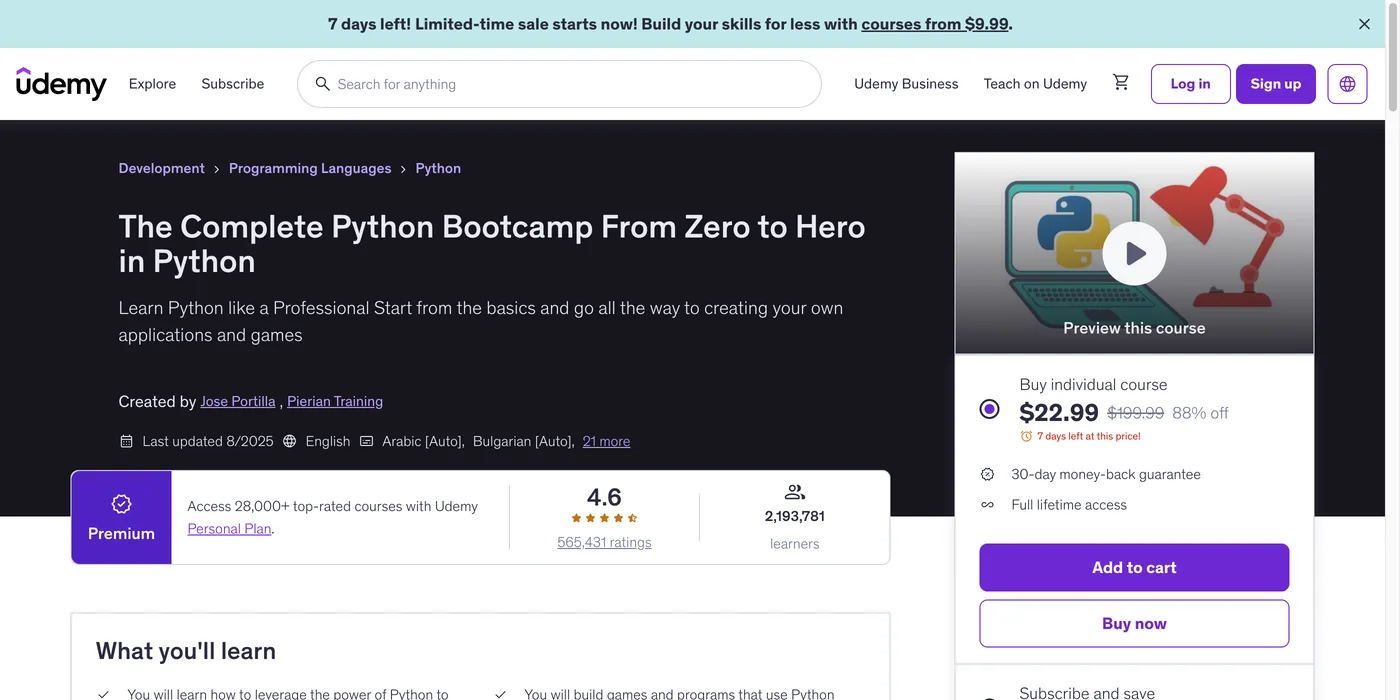
A long way. Here is the best-selling Python course on Udemy, captured on the day this page was checked:
How we verified
We captured this directly from udemy.com/course/complete-python-bootcamp in August 2026 — not from an affiliate roundup. The instructor picked the $199.99 rung. Udemy picked $22.99. An organic sale at that price pays the instructor 37% of $22.99, or $8.51. Pricing pages change, so we date every screenshot.
That happens through the Deals Program, and the important detail is the default: every instructor is opted into it when they register as a premium instructor. Inside Deals, Udemy generates a market-specific price using what it describes as data science and economic modeling, and the only hard limit is a local floor — $9.99 in the US, €9.99 and £9.99 in Europe, ₹399 in India, R$24.90 in Brazil, MX$129 in Mexico, and so on down its matrix.
The page most instructors never find is the one that says you can leave. Udemy's own words: instructors "can opt out of the program at any time," and courses belonging to instructors who are not in Deals "are not included in sitewide discount campaigns." Your list price then stands.
Leaving isn't free. Active campaigns keep discounting for up to ten days afterwards, and opting out also pulls your courses from Udemy's search advertising, social placements, retargeting and affiliate marketing. You're trading Udemy's price control for Udemy's marketing, which is a real trade rather than an obvious win — and it's the hinge the whole rest of this page turns on.
Two smaller mechanics worth knowing. New paid courses are exempt from Udemy promotions for their first 14 days in some markets, including the United States, France, Japan and Turkey. And if Udemy sells your course through a reseller below the permitted floor, it calculates your share from the floor rather than the lower price — a rule that works in your favor and that nobody writes about.
Coupons, referral links, and the difference nobody explains
These two instruments both pay 97%, and almost every article treats them as the same thing. They aren't.
Coupons are rationed. You can create up to three per course per month, in four types, with expiry dates between 5 and 31 days. If you're in the Deals Program your coupon prices are also bounded from below: a "Custom price" coupon's floor is, in Udemy's phrasing, "similar to (but not necessarily lower than) the price Udemy would offer a given student." So the discount you thought you were giving is partly Udemy's decision.
Referral links are unlimited. Every paid course has one permanently. Click it and buy within 24 hours and you're credited with the sale, wherever the click came from. And then the sentence that changes the arithmetic, verbatim from Udemy's help center:
"Referral links have no influence on the price displayed to learners. If you have opted into Udemy Deals, learners may be offered a discount for your course when following your referral link. If you have not opted into Deals, however, learners will always see your list price when following a referral link."
Read that as a lever rather than a footnote. Opt out of Deals, drive your own traffic through a referral link, and a $49.99 course sells at $49.99 and pays you $48.49. That is the highest-paying route on Udemy by a distance, and it is the reason the honesty section further down exists.
What do you earn from Udemy Business and the subscription plans?
Nothing that works like a sale. Udemy sets aside 15% of monthly subscription revenue as an instructor pool, and your slice of that pool is your slice of every minute consumed across all the courses in it. Watch 3% of the minutes, get 3% of the pool. Minutes count video plus practice tests, quizzes, coding exercises and the AI Assistant, including re-watches and offline mobile viewing. Personal Plan and Starter Plan pay by the same calculation; Starter Plan adds a separate pool of 25% of eligible advertising revenue.
That 15% is the end of a ladder Udemy walked down deliberately, and the dates come straight from its final annual report: 20% effective January 1, 2024, then 17.5% on January 1, 2025, then 15% on January 1, 2026. (You will see a 25% starting figure quoted around the web. We could not source it to any Udemy document, so this page starts the ladder at 20%.)
Udemy also said, in the same filing, what those cuts contributed. Net income improved by $89.3 million in 2025 — its first profitable year — and Udemy attributes the swing to "the reduction in the instructor revenue share for all subscription offerings, the continued shift in mix of revenue toward" its higher-margin lines, among other factors. So the pay cut is the first driver Udemy names, not the only one; we'd rather quote it that way than crop the sentence. And in the risk factors: the changes "could result in instructor attrition." A company telling the SEC that reducing instructor pay helped produce its first profitable year, and naming instructor attrition as the risk, needs no editorial from us.
The practical problem with pool income isn't the rate. It's that you can't forecast it. Your earnings depend on total subscription revenue and total platform-wide minutes watched, neither of which Udemy publishes, and both of which move for reasons that have nothing to do with you. A percentage of a sale you can plan around. A share of an unpublished pool you can't.
There are two bonuses worth knowing about, since nobody documents them: if your coupon or referral link produces a new consumer subscription rather than a course sale, you get 50% of the net first-month revenue, and if your course landing page was the last paid landing page a subscriber visited within 24 hours, you get 16% of a monthly plan's net initial fee or 3.2% of an annual one.
How much do Udemy instructors actually make?
Udemy's last annual report answers this better than any salary-aggregator page can. In 2025, instructors collectively earned $168 million, and Udemy had relationships with more than 91,000 instructors as of December 31 that year.
Divide one by the other and you get about $1,846 for the year, or $154 a month. That's our arithmetic, not Udemy's, and it's a mean rather than a median — which matters more here than usual, because the same filing says Udemy's top 11 instructors each earned more than $1 million and that nearly 1,600 instructors earned more than the average annual income in their home country. Eleven millionaires and 1,600 people making a living, out of 91,000. The long tail underneath drags the typical figure well below $1,846, and Udemy doesn't publish the median.
For scale on the competition you'd be publishing into, from the same filing: more than 290,000 courses in 78 languages, with an average of over 6,300 new courses added every month during 2025.
When do you actually get paid?
Later than you would expect, and there is a floor.
Marketplace earnings run on roughly a 60-day lag. January's sales are paid within the first ten business days of March. The reason is the 30-day refund window: Udemy won't process a refund after the money has gone out, so it waits the window out first. Udemy Business and subscription earnings move faster, appearing after seven business days of the following month.
Then the minimum. A payout is only issued if the amount owed is at least $25; anything below that is held and swept out once a year, in December. Put that together with the $9.99 floor and the shape of a first year on Udemy becomes concrete: ten organic sales at the promotional floor earns $37, and if those are spread across the year in small monthly amounts, a good chunk of it waits until December.
What Udemy's rules let you do off-platform — and what they don't
This is the question people ask most often and get wrong most often, so here is what the terms actually say.
You may run your own course site. The subscription program's exclusivity clause asks you not to offer directly competing on-demand content elsewhere, and then carves out an exception in Udemy's own words: "This does not apply to content on your personal or professional websites, or to separate offerings such as in-person training, books, or coaching." Note the exclusivity persists for up to 12 months after you opt out.
You largely may not promote it from inside the course. Udemy's course content rules prohibit links to paid content off Udemy, affiliate links, and coupon codes. A newsletter signup link is permitted only in the bonus lecture, and contact details only as a small watermark.
You cannot give the same course away free elsewhere. Twice, verbatim, in two different help articles: "courses that you charge for on Udemy cannot be offered for free off of Udemy (e.g. YouTube, your own site, other sites)."
Free to paid is a one-way door. A published course can be switched from free to paid exactly once. Flip it back and its promotional announcements are permanently disabled.
A quiet course can be unpublished. Under the Marketplace Maintenance Program, Udemy periodically unpublishes content showing little to no recent engagement. Three conditions have to be true together — little recent enrollment, revenue or engagement; no historically significant enrollment, revenue or engagement; and no update in the last six months. Enrolled students keep their access, but new enrollments stop, and you are emailed only the first time a given course is flagged.
And the AI program is opt-out, not opt-in. All instructors are included in Udemy's genAI program by default and can only leave during designated annual periods. Opting out means your content is removed from those features by year end, you lose Udemy's instructor AI tools, and you may be excluded from new revenue streams tied to them. It does not stop Udemy applying AI to your content for search, recommendations, marketing, fraud detection and transcripts.
Is Udemy worth it for instructors?
It depends far more on what you're teaching and who you already reach than on the percentages. Four honest answers:
Yes, clearly — if you have no audience and your topic has marketplace demand. If nobody would come to a launch email because you don't have a list, then 37% of a sale Udemy found is infinitely better than 100% of a sale that never happened. Broad technical topics with steady search demand are what the marketplace is good at. Volume over margin is a coherent strategy and Udemy is the best place to run it.
Yes, as one channel — if you use it for discovery and keep the real program elsewhere. This is the most common pattern among instructors who are happy. An introductory course on Udemy does the reaching; the cohort, the coaching, the certification live somewhere you control. Udemy's own terms permit this arrangement, and the section above quotes the clause.
Probably not — if your program is worth more than $199.99, or needs a start date. There's no rung above $199.99 and no mechanism for a cohort, a live session with the group, or a certificate. This isn't a pricing complaint; it's a structural one. A program whose value depends on people going through it together at the same time has nowhere to sit on Udemy at any volume.
No — if you already have a list. Every organic sale is a person you could have reached yourself, sold to at 37 cents on the dollar, and whose email address you then don't get. If your list is the reason people buy, Udemy is charging you 63% for an introduction you had already made.
The awkward part of this is that the second answer and the fourth answer are the same person two years apart, and nothing on Udemy tells you when you crossed over. The next section puts a number on it.
At how many sales does your own platform cost less?
Two tables, both with the arithmetic showing. The Ruzuku column is Core billed annually at $997, selling a $49 course through your own Stripe account at 2.9% + $0.30 — so $47.28 net per sale, less $997 a year.
Same learners, Udemy at its promotional price
This is the comparison a real instructor faces. On Udemy the learner pays $14.99 because Udemy set that price. On your own site the same person pays $49 because you set it.
| Sales a year | Udemy marketplace @ $14.99 | Your referral link @ $14.99 | Ruzuku Core @ $49 |
|---|---|---|---|
| 50 | $277.32 | $727.02 | $1,366.95 |
| 500 | $2,773.15 | $7,270.15 | $22,642.50 |
| 5,000 | $27,731.50 | $72,701.50 | $235,398.00 |
Same price on both sides, Deals opted out
This one isolates the revenue share by itself: a $49.99 list price on Udemy with promotions switched off, against $49 on your own site.
| Sales a year | Udemy marketplace @ $49.99 | Your referral link @ $49.99 | Ruzuku Core @ $49 |
|---|---|---|---|
| 50 | $924.82 | $2,424.52 | $1,366.95 |
| 500 | $9,248.15 | $24,245.15 | $22,642.50 |
| 5,000 | $92,481.50 | $242,451.50 | $235,398.00 |
Setting the two sides equal and solving for the number of sales gives four crossover points. Each is the sales-per-year figure where your take-home pay on your own site overtakes your take-home on Udemy, after Core's $997 annual fee:
| Against | The arithmetic | Own platform wins from |
|---|---|---|
| Marketplace @ $14.99 | $41.73 more per sale ÷ $997 | 24 sales a year |
| Referral link @ $14.99 | $32.74 more per sale ÷ $997 | 31 sales a year |
| Marketplace @ $49.99 list | $28.78 more per sale ÷ $997 | 35 sales a year |
| Referral link @ $49.99 list | Udemy pays $1.21 more per sale | Never |
About 24 sales a year — two a month — is where you start taking home more from your own site than from Udemy. The line really does sit between 23 and 24: at 24 sales your own site nets $137.70 against Udemy's $133.11, and at 23 it's $90.42 against $127.56 and Udemy is still ahead.
Be careful with what that number is, because most pages in this category blur it. It's an earnings crossover, not a fee crossover, and it depends on the price change as much as the fee: you're comparing a course Udemy sells for $14.99 against the same course you sell for $49. Raising the price is doing a lot of the work.
The pure fee question is a different sum with a different answer. If you changed nothing but who takes a cut — same $14.99, same buyers — Udemy's 63% only costs more than Core's $997 once your marketplace sales pass about $1,582 a year, which at $14.99 a sale is roughly 106 sales. At $49.99 list with Deals switched off it's about 32. So: 24 sales if you're willing to reprice, around 106 if you aren't. Both are true; they answer different questions.
If you're well past 24 — a few hundred sales a year — stop looking at the crossover. At that volume the fee arithmetic is obvious and it isn't your real question. Your real question is what share of those sales you could have made without Udemy, and Udemy will tell you: on a course page, under Performance, the Traffic & conversion tab breaks your landing-page visitors down by channel. Udemy Search and Udemy Discovery are the marketplace doing the work you're paying 63% for. Instructor Promo is your own coupon and referral traffic. Outside Sources is everyone who found you through Google or a link from a friend. Go and read that split before you read anything else here. If it's nearly all Udemy Search and Discovery, that 63% is buying you something real. If Outside Sources is already a third of it, you're paying Udemy 63% on work you did yourself.
Two caveats that move every number above. Certificates, a custom domain, white-label branding and multiple instructors are on Pro at $1,997 a year rather than Core's $997 — if your program needs a certificate, double every crossover in the table. And all of these use Core's annual price of $997; month to month it's $1,188, which pushes the first crossover from 24 sales to 29.
A word about how this comparison usually gets presented, including by us. Take your Udemy revenue, multiply by 63%, put the result next to $99 a month, and you get a large number with a dollar sign on it — but that sum quietly assumes every one of those sales follows you off Udemy. Most won't. If Udemy's search found the buyer, Udemy keeps the buyer. Read the tables above as what a sale is worth once you can already make it, not as money sitting on the other side of a migration.
When Udemy is the cheaper option
The last row of that table isn't a rounding error, and it doesn't close at higher volume. It's worth stating as plainly as we can.
If you drive your own traffic through a referral link, keep the course out of the Deals Program so the link shows your full list price, and are content sending buyers to a Udemy checkout, Udemy pays you more than we do — forever. A $49.99 sale pays $48.49 on Udemy against $47.28 on Ruzuku Core. That $1.21 per sale never reverses, because there is no flat fee on Udemy's side to amortize away. At 5,000 sales a year Udemy is roughly $7,000 ahead.
We would rather write that sentence than have you find it yourself and stop trusting the rest of the page. It is also, in practice, a narrower case than it looks, and the conditions that narrow it are each verifiable:
- You can't price above $199.99 or below $19.99, and only on 29 fixed rungs.
- You never get a student's email address, so each sale is a transaction rather than a relationship.
- You can't link to your own paid content, an affiliate offer or a newsletter from inside the course, except in the bonus lecture.
- You can't give the same course away free on your own site or on YouTube.
- You're paid about 60 days later, and not at all below $25 until December.
- Udemy can unpublish the course if it goes quiet for six months without an update.
- Opting out of Deals removes you from Udemy's search ads, social placements, retargeting and affiliate marketing — so the traffic you're driving is now all of your traffic.
That last one is the pivot. The scenario where Udemy pays better is exactly the scenario where Udemy has stopped doing the thing you were paying it for.
Who should stay on Udemy?
Most articles in this category conclude "switch." Here is the group for whom that is wrong, with numbers rather than vibes.
Stay if you're running the referral-link play above — out of Deals, driving your own traffic, selling at list. Udemy pays 97% with no monthly fee, and no flat-fee platform can beat that on price alone. Move only if you want the email addresses, a price above $199.99, or a cohort.
Stay if you have no audience and no immediate plan to build one. Below roughly 24 sales a year you take home more on Udemy than you would on your own site after its annual fee — and if you can't reprice above Udemy's promotional level, that line moves out to about 106 sales. More to the point, a flat fee buys you tools to sell to a list you don't have yet. Come back when you have one.
Stay if your topic is one the marketplace actively demands. Broad technical and professional subjects with steady search volume are what Udemy's discovery engine is good at. If a meaningful share of your enrollments arrive without you doing anything, that's a service, and 63% is what it costs. The test is whether you can name roughly what that share is. If you can't, you may be paying for discovery that isn't happening.
A concrete version, because it's the shape we hear most. Say you have three courses, no email list, and learners are spending about $600 a month on them, nearly all through Udemy's own promotions. At the 37% organic rate that's roughly $222 to you and $378 to Udemy. (If $600 is what actually lands in your account rather than what learners spend, scale it up — learners are spending nearer $1,620 and Udemy is keeping about $1,020.) Either reading puts you well past both crossover points, and the fee arithmetic says move.
The fee arithmetic isn't your binding constraint, though. Moving to Core costs you the discovery that produced all of it, and the referral-link route only pays 97% on traffic you can already reach — with no list, you don't have any yet. So the first move isn't a migration, and it isn't a referral test either. It's building the one asset Udemy structurally won't give you. Add the newsletter signup Udemy permits in your bonus lecture, put your own site in your instructor profile, and count how many people arrive over ninety days. If it's a hundred, you have a business off Udemy and the tables above start applying to you. If it's four, stay, keep collecting the 37%, and read this page again next year.
Can you run both?
Yes, and Udemy's own terms say so — the carve-out for "content on your personal or professional websites" is quoted above. The usual shape is Udemy as the wide, cheap top of a ladder and everything with a price above $199.99 living elsewhere.
Dr. Ken Long runs a version of that ladder on Ruzuku: free artifacts, then mini courses, then self-paced foundations, then cohort coaching, then one-to-one advising. More than 100 published courses across three teaching streams, 17,000-plus lesson completions, 620-plus students averaging about three courses each. He didn't come from Udemy, and we're not presenting him as a migration story. He is the shape of the argument: the top three rungs of that ladder — cohorts, coaching, one-to-one — have no rung on Udemy's matrix at any price and no mechanism in its product. A $199.99 ceiling isn't a pricing constraint on that business. It's a structural one.
The practical warning is the content rules. You may run the site; you mostly may not point at it from inside the course. Design the ladder so the handoff happens in the bonus lecture, in your Udemy instructor profile, and in the places learners look for you by name — not in lecture 4.
One gap we should name rather than paper over: we can't point you at a Ruzuku customer who moved a Udemy catalog across and tell you what happened to their revenue. We looked for one in our own support history and didn't find it. That's a weaker claim than a migration story would be, and it's the only one we can honestly make.
What does your own platform charge instead?
Ruzuku Core is $99 a month, or $997 a year, with unlimited courses and unlimited students and no revenue share of any kind. You sell through your own Stripe account, so the only per-sale cost is Stripe's published 2.9% + $0.30, which goes to Stripe rather than to us.
What that changes, in the order it usually matters:
- You set the price. Any number, no rungs, no ceiling, and payment plans if the number is large. Nobody discounts your course to $9.99 the week before your launch.
- You get the email addresses. Every student is somebody you can tell about the next thing. This is the difference that compounds, and it's the one Udemy structurally can't give you.
- You can teach live. Ruzuku has built-in video meetings — browser-based, no Zoom account needed, 60 people in a conference or 250 in a presentation, on every plan — plus a Zoom integration when you want breakout rooms or a bigger room. Udemy's Connect 1-1 is invite-only, one-to-one, and runs over Zoom, with Udemy taking 20% of the session fee per its own revenue-share article.
- Discussions, assignments and drip are part of the course, not a Q&A tab beside it.
- A real person answers support, for you and for your students.
Certificates, a custom domain, white-label branding, multiple instructors and the storefront are on Pro at $199 a month or $1,997 a year. If you need any of those, compare against that number rather than $997.
The thing Core doesn't give you is Udemy's roughly 84 million learners — the figure in its final annual report, for the year to December 31, 2025. That's the entire trade, and it is worth being blunt about: moving off Udemy means the marketing becomes your job on day one. If you have no plan for that, the break-even table isn't describing your situation.
So which one fits what you're building?
Udemy, if you need discovery more than margin, your material fits under $199.99, and you're content with a transaction rather than a relationship. Get out of Deals and use referral links for anything you drive yourself — the difference between 37% and 97% is larger than the difference between any two platforms on this site.
Your own site, once you clear roughly 24 sales a year and you can charge more than Udemy's promotional price and you have somewhere to send people from — or as soon as what you teach needs a start date, a group, a live session, a certificate, or a price Udemy has no rung for.
Both, most likely, for a while. Udemy's terms permit it, the ladder shape is well tested, and running the two in parallel is the only way to find out how much of your Udemy revenue is really Udemy's discovery and how much is yours.
If you want to try the owned side, our free plan is deliberately small: up to five paying students, no card, no transaction fee. That isn't enough to move a Udemy catalog onto, and it isn't meant to be — it's enough to run the test above. Put your smallest course up, price it at what you actually think it's worth, and send five people to it from the places Udemy's rules allow. If five people you found yourself pay $49, you've learned more about your business than this page can tell you. If nobody does, you've learned that too, and it cost you nothing.
Related resources
- Course marketplaces vs your own platform — the category question, and the Skillshare half of it
- Skillshare for course creators — the royalty model, which works nothing like Udemy's
- Every course platform's pricing, compared
- How to price your own course — useful the moment you're no longer picking from 29 rungs
Real-World Cost Scenarios
What Udemy actually costs at three revenue levels — including fees, add-ons, and the plan you'd really need.
Side income
$500/mo revenueUdemy
$315/mo
Udemy's 63% marketplace share: $315/mo
Annual: $3,780/yr
Ruzuku
$99/mo
Core ($99/mo): $99/mo
0% platform fee (standard Stripe 2.9% + $0.30)
Annual: $1,188/yr
What you get on Udemy
- Udemy finds the students
- Nothing to pay up front
- Checkout, tax and refunds handled
What you'll still need
- A way to reach buyers yourself — $315 of the $500 is Udemy's finding fee
- An email list; Udemy hands over no addresses
- Price control, and the sales themselves if you leave
Full-time instructor
$2,500/mo revenueUdemy
$1,575/mo
Udemy's 63% marketplace share: $1,575/mo
Annual: $18,900/yr
Ruzuku
$99/mo
Core ($99/mo): $99/mo
0% platform fee (standard Stripe 2.9% + $0.30)
Annual: $1,188/yr
What you get on Udemy
- Marketplace discovery at volume
- Still no monthly fee
What you'll still need
- A marketing channel of your own — Udemy keeps $1,575 a month
- Any way to price above $199.99
- Something to sell a past student next year
Established catalog
$10,000/mo revenueUdemy
$6,300/mo
Udemy's 63% marketplace share: $6,300/mo
Annual: $75,600/yr
Ruzuku
$99/mo
Core ($99/mo): $99/mo
0% platform fee (standard Stripe 2.9% + $0.30)
Annual: $1,188/yr
What you get on Udemy
- Large marketplace reach
- Udemy carries the marketing cost
What you'll still need
- Your own discovery — Udemy keeps $6,300 a month
- Student relationships you can carry forward
- A course that stays published without a six-month update
Udemy vs. Ruzuku: Honest Comparison
A fair, side-by-side cost comparison focused on what matters most to course creators.
| Feature | Udemy | Ruzuku |
|---|---|---|
| Monthly cost | $0 — free to publish | $99/mo (Core), $997/yr |
| What you keep per sale | 37% when Udemy finds the student, 97% when you do | Everything but Stripe's 2.9% + $0.30 |
| Price control | 29 fixed rungs, $19.99-$199.99; Udemy can discount to $9.99 | Any price, any structure, including payment plans |
| Price ceiling | $199.99 | None |
| Student contact details | No email addresses — the student list has no email column | Yours to export |
| Branding | Udemy's | Yours; white-label and custom domain on Pro |
| Built-in audience | Roughly 84 million learners | You bring your own |
| When you get paid | About 60 days after the sale, $25 minimum | Your own Stripe account, on Stripe's normal payout schedule |
| Course features | Video, quizzes, practice tests, coding exercises, labs, assignments, AI assistant | Video, quizzes, assignments, drip, discussions, live meetings |
| Live sessions | Connect 1-1 beta — invite-only, one-to-one, joined over Zoom, 20% to Udemy | Built-in video meetings (60 conference, 250 presentation) with no Zoom account needed, plus an optional Zoom integration |
| Student tech support | Udemy handles it | Ruzuku handles it |
Choose Udemy if:
You have no audience yet and your topic has steady marketplace demand — volume at $8 a sale beats margin you cannot go and find. Udemy also wins outright at any volume on one specific play: your own referral link, Deals switched off, list price showing.
Choose Ruzuku if:
You already have a list, or your program is worth more than $199.99, or it needs a start date, a cohort, a live session or a certificate. Past roughly 24 sales a year you take home more on your own site than on Udemy — provided you can charge more than Udemy's promotional price.
Udemy Pricing FAQ
What is the Udemy subscription price, and how does the Personal Plan pay instructors?
Udemy's Personal Plan subscription costs learners approximately $30/month (or ~$240 to $360/year) for access to roughly 10,500 curated courses. Instructors whose courses are enrolled in the subscription catalog do not get paid per course sale; instead, they share a fixed 15% revenue pool distributed strictly by the proportion of total minutes watched across all subscribed learners.
How much does Udemy pay instructors per sale?
It depends on who found the student. Udemy pays you 37% of the net sale amount when its own marketplace, search or advertising made the sale, and 97% when the student used your coupon or referral link. Net amount means what the student paid less taxes and any app-store fee, so a sale through the iOS or Android app has Apple's or Google's 30% removed first — an organic mobile sale nets you about 25.9% of what the learner actually paid. Udemy also sets the sale price on marketplace sales, and its promotions can take a $199.99 course down to $9.99.
Does Udemy take 63% or 3% of my sales?
Both, on different sales. Udemy takes 63% of any sale it originates and 3% of any sale you originate through your own coupon or referral link. Neither number is the one most instructors actually experience across a whole year: in 2025 Udemy paid instructors 32% of everything learners spent on its consumer marketplace, which tells you self-driven sales are rare enough that the blended result sits close to the 37% organic rate.
Can Udemy discount my course without asking me?
Yes, if you are in the Deals Program — and every new premium instructor is opted into it by default. Udemy then sets a market-specific price using its own modeling, with a floor of $9.99 in the United States or the local equivalent. You can opt out at any time, which restores your list price, but active campaigns keep discounting for up to ten days and your courses come out of Udemy's search ads, social placements, retargeting and affiliate marketing.
What is the highest price I can charge on Udemy?
$199.99. Udemy's global price matrix has 29 fixed rungs in USD, running from $19.99 at the bottom to $199.99 at the top, and you pick a rung rather than typing a price. The $19.99 floor on list prices surprises people as often as the ceiling does. Promotional prices go lower still, down to a $9.99 floor.
When does Udemy actually pay instructors, and is there a minimum?
Marketplace earnings are paid roughly 60 days after the sale — January's sales arrive in the first ten business days of March — because Udemy waits out the 30-day refund window first. There is a $25 minimum: any balance below it is held and paid out in December. Udemy Business and subscription earnings run on a faster clock, appearing after seven business days of the following month.
Can I sell the same course on Udemy and on my own website?
Yes, and Udemy's subscription terms say so directly. The exclusivity clause asks you not to offer competing on-demand content on other sites or platforms, then carves out an exception: it does not apply to content on your personal or professional websites, or to separate offerings such as in-person training, books, or coaching. Two other rules do bite. A course you charge for on Udemy cannot be given away free on your own site or YouTube, and inside the course you may not link to your own paid content, an affiliate offer, or a newsletter signup except in the bonus lecture.
At how many sales a year does my own course platform beat Udemy?
About 24, if you can reprice. At Udemy's own example promotional price of $14.99 an organic sale pays you $5.55, while a $49 sale on your own site through Ruzuku Core nets $47.28 after Stripe's fee. Twenty-four sales a year covers Core's $997 annual fee and puts you ahead; at 23 sales Udemy is still ahead. That is an earnings comparison, and the price change does much of the work. If you keep the price at $14.99 and change only who takes a cut, Udemy's 63% costs more than $997 only once marketplace sales pass about $1,582 a year, or roughly 106 sales. Both figures move if you need certificates or a custom domain, which are on Pro at $1,997 a year.