Short answer: yes, Kajabi is a capable all-in-one platform — especially if you want email marketing, sales funnels, and courses under one roof. Plans run $143–$399/month billed annually, or $179–$499 month to month, with 0% transaction fees via Kajabi Payments. But the high entry price, aggressive feature-gating, and 2025 price restructuring mean it's not the right fit for everyone.
What Is Kajabi?
Kajabi is an all-in-one marketing platform with courses built in. It targets entrepreneurs who want email marketing, sales funnels, landing pages, and course hosting in a single tool. In 2025, Kajabi restructured its pricing — raising Basic, Growth, and Pro prices and adjusting product and contact limits. The entry-level Kickstarter plan ($89/mo) is no longer offered to new creators; existing Kickstarter accounts kept $89.
Is Kajabi Worth It in 2026? The Return vs Dedicated Course Platforms
The 2026 Verdict: Kajabi is worth its premium starting price ($143–$399/month) only if you actively run complex marketing pipelines, email funnels, and landing pages inside its all-in-one ecosystem to replace multiple paid marketing tools.
Kajabi is NOT worth it if:
- You prioritize teaching and student outcomes: If your core focus is cohort delivery, live workshops, or student engagement, dedicated teaching platforms like Ruzuku ($83.08/mo billed annually, or $99/mo monthly) cost less than Kajabi Basic and are built around discussion and live sessions.
- You already have an email provider: If you use Kit (ConvertKit), Mailchimp, or ActiveCampaign, you are paying double for features you won't use on Kajabi.
- You want to avoid subscriber lock-in: Kajabi Payments locks subscription relationships to their proprietary gateway, making future platform migrations painful unless you pay external Stripe surcharges (0.5–2%).
Here’s my plain read. Kajabi suits you if you sell through email sequences, sales pages, and funnels, and you want them in the same place as your courses. That’s what it does well. If your work is teaching a group, with discussion and live sessions, you’ll pay for a marketing suite you won’t use. In that case, try Ruzuku’s free plan with no time limit first. It holds up to 5 students, so you can run a small pilot before you pay anyone. On every plan, our support team also answers your students’ login and access questions, so you don’t have to.
A visual artist who moved her courses from Ruzuku to Kajabi in January 2020 put the case for Kajabi well. Checkout pages, landing pages, and pipelines are still on every Kajabi plan today:
"We wanted to streamline our checkout process, we wanted to host more of our website Sales Pages there, and I wanted to host our funnels/pipelines there as well, instead of on ClickFunnels. Kajabi gave us the ability to do all of these things."
How Much Does Kajabi Cost? Pricing Plans (2026)
Kajabi offers three plans with 0% transaction fees via Kajabi Payments. Annual billing saves about 20%. For a deep dive with real-world cost scenarios, see our complete Kajabi pricing breakdown.
| Plan | Monthly | Annual | Products | Contacts |
|---|---|---|---|---|
| Basic | $179/mo | $143/mo | 5 | 2,500 |
| Growth | $249/mo | $199/mo | 50 | 25,000 |
| Pro | $499/mo | $399/mo | Unlimited | 100,000 |
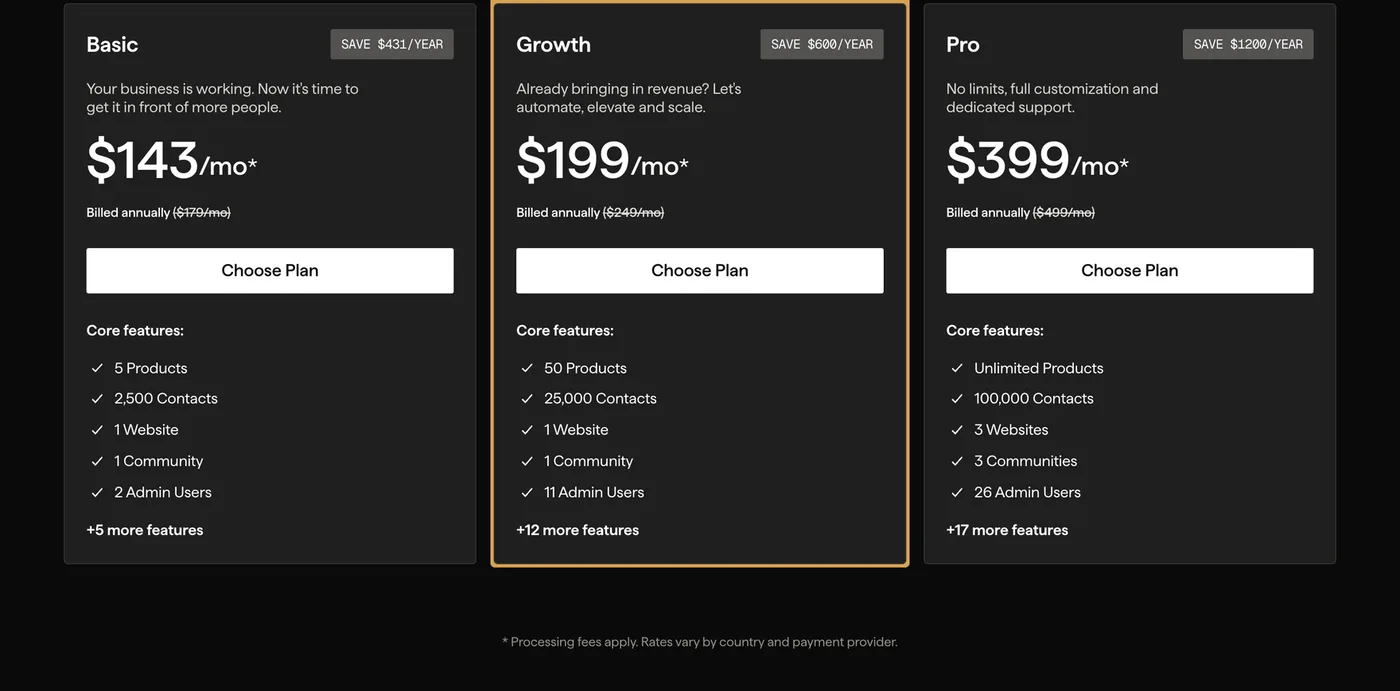
How we verified
We captured this directly from kajabi.com/pricing in June 2026 — not from an affiliate roundup. Prices shown are annual billing; month-to-month runs higher ($179/$249/$499). Kajabi notes processing fees vary by country and provider. Pricing pages change, so we date every screenshot.
The 2025 price restructuring: Kajabi raised the Basic plan from $149/mo to $179/mo, and the Growth plan from $199/mo to $249/mo. Contact limits on Basic were cut from 10,000 to 2,500. The cheapest entry point is now $143/month (annual billing) — the highest starting price in the course platform market.
For the plan-by-plan breakdown of what Basic allows and locks out — the 5-product cap, 2,500-contact ceiling, and the features held back for Growth and Pro — see what each Kajabi plan includes in 2026.
3rd-party payment surcharge: If you use your own Stripe instead of Kajabi Payments, there's an additional surcharge: 2% on Basic, 1% on Growth, 0.5% on Pro — on top of Stripe's standard rates.
The subscription surcharge most reviews miss: Even when you use Kajabi Payments, the headline "2.9% + 30¢" rate isn't the whole story. Per Kajabi's own help center, Kajabi adds 0.7% on every subscription or payment plan transaction, plus another 1.5% on international cards. For a course business running on memberships or payment plans (which is most of them), the real effective rate on Basic is 3.6% + 30¢, not 2.9%. International subscription sales hit 5.1% + 30¢. Buy Now, Pay Later via Afterpay or Klarna runs 6%. None of this is on the Kajabi pricing page. See my Kajabi pricing guide for the full fee breakdown, or my hidden course platform fees overview comparing every major platform's undisclosed costs.
Total Annual Cost: Kajabi vs Ruzuku
Kajabi (own Stripe: 2% surcharge on Basic, 0.5% on Pro) vs Ruzuku (0% Ruzuku platform fee)
At $1,000 monthly revenue
At $5,000 monthly revenue
At $20,000 monthly revenue
Includes platform subscription + transaction fees. Standard payment processing (Stripe 2.9% + $0.30) applies to all platforms and is excluded.
What Are Kajabi's Key Features?
Kajabi's strengths center on its all-in-one approach:
- Email marketing built-in — Sequences, broadcasts, automations, and a visual email builder. No need for Mailchimp or ConvertKit.
- Sales funnels and landing pages — Complete pipeline builder for webinars, challenges, product launches, and evergreen funnels.
- Comprehensive marketing automation — Tag-based automation, conditional logic, and behavioral triggers (Growth plan and up).
- Branded mobile app — On the Pro plan ($499/mo), you can offer students a branded mobile app experience.
- 0% platform transaction fees on Kajabi Payments (though processing rates include 0.7% subscription and 1.5% international card surcharges per Kajabi's KB) — Unlike Teachable and Mighty Networks, Kajabi doesn't take a cut of your sales (using Kajabi Payments).
Kajabi Updates in 2025-2026
Kajabi has made several significant changes recently:
- Kickstarter plan off the pricing page — New creators can no longer buy the entry-level $89/mo plan; existing Kickstarter accounts kept that price
- Prices raised across all tiers — Basic +$30/mo, Growth +$50/mo, Pro +$100/mo
- Contact limits reduced on Basic — From 10,000 to 2,500 contacts
- Product limits increased — Basic went from 3 to 5 products, Growth from 15 to 50
- AI credits added — Basic includes 0 AI credits, Growth 500 and Pro 1,000 a month; extra credits cost $15/month per 500. Video transcriptions and translations are listed on every plan, but generating them uses AI credits, so Basic users have to buy credits or upload their own .srt caption file.
- Admin users expanded — Basic: 2, Growth: 11, Pro: 26
- Marketing form limitation — Only 50 form fields across an entire account, a ceiling that becomes restrictive as businesses grow
For the old and new price of each plan, and the January 13, 2026 date the increase reached existing customers, see the price-change record in our Kajabi pricing guide.
What Is Kajabi Best For? (And Where It Falls Short)
Where Kajabi excels:
- Marketing-heavy businesses that need email, funnels, and courses consolidated
- Entrepreneurs who want one platform instead of integrating multiple tools
- Established creators with budget for premium pricing ($143-$399/month)
Where it falls short:
- Expensive entry point — The cheapest plan is $143/mo (annual). There’s no free plan. Kajabi offers a free 30-day trial and a 30-day money-back guarantee, and after that the floor is $143/mo.
- Aggressive feature-gating — Affiliates, advanced automations, cohort courses, and branding removal all require Growth ($249/mo) or higher. See the full feature-gating breakdown.
- Rising prices — The 2025 pricing restructuring frustrated existing users, with a Change.org petition and widespread complaints on Reddit and Trustpilot.
- Overkill for teaching-focused creators — If you don't need funnels and email automation, you're paying for features you won't use.
For the complete plan-by-plan cost math — including the 0.5%–2% Stripe surcharges, contact limits, and plan comparison — see our dedicated Kajabi pricing breakdown.
Kajabi Community Features
Kajabi includes community spaces on all plans, but with significant limits: 1 community on Basic and Growth, 3 on Pro. Each community is a separate discussion space where members can post and interact — but it exists alongside your courses, not integrated into the learning flow.
The community features include discussion threads, member directories, content gating, and event scheduling. What's missing: no native video conferencing within the community (live sessions require external tools or Kajabi Events broadcasts), no gamification (unlike Skool), limited moderation tools, and no way to embed discussion directly into course lessons.
That gap shows up in cohort programs. A course facilitator ran her program on Ruzuku, and her team then moved it to Kajabi. In April 2024 she wrote to ask about coming back:
"I highly dislike the Kajabi format... In fact, the exchange among participants was dramatically reduced."
At $143/month minimum for one community, Kajabi costs more than some dedicated community platforms, such as Circle or Mighty Networks. If community is central to your business model, see our full Kajabi Community review for a detailed breakdown of features, limits, and alternatives.
What Educators Tell Us
We've had nearly 480 support conversations where educators mention Kajabi — making it the most-discussed competitor in our support history. Here's what those conversations reveal.
What they like about Kajabi: Beautiful design templates, built-in CRM and email marketing, and a true all-in-one approach. If you fully use every feature — email sequences, funnels, memberships, courses — the consolidated toolset can be convenient and replace several separate subscriptions.
Rising prices and support quality: These are the two most common complaints. In October 2024, a team running several Kajabi course sites told us they were “not happy with the customer service and the increasing price for each website.” Ease of use comes up too. In 2019, an educator who had paid $997 as a founding member of New Kajabi wrote, “I find their platform difficult to use.”
A creator building an online workshop program on Kajabi wrote to us in February 2023. He had his site working, but it had cost him:
"I have spent at least 100 real and valuable hours frustratedly sorting through the poorly documented (outdated instructions and terminology), poorly designed... and somewhat illogical structure of Kajabi's system... I have been very dissatisfied with Kajabi's support policies and support system."
Per-site pricing and complexity: Educators running multiple businesses or course topics pay separately for each Kajabi website. In July 2024, a coach who advises course creators told us her clients were “asking me to recommend a LMS and that Kajabi is not the way they wish to go.” When you’re paying for funnels, email marketing, and a website builder you don't use, the value equation shifts.
The completion rate problem: Educators who switch often cite learning and engagement features as the pull. In 2020, a wellness coach told us her course had run on Kajabi the year before: “Approximately 14 people enrolled, and probably 5-6 completed all the lessons.” She asked how a relaunch might bring in a higher completion rate. Kajabi’s strengths are in selling courses. Getting students to finish them is up to you.
Migration is rebuilding: Moving from Kajabi means exporting email lists as CSV files and rebuilding automations, funnels, and course structures from scratch. There's no automated migration path.
How Does Ruzuku Compare?
Where Kajabi is built for marketing-first entrepreneurs, Ruzuku is built for teaching-first educators:
- Purpose-built for learning — Ruzuku's entire design focuses on the student experience: discussions, progress tracking, and structured learning journeys.
- Built-in video meetings + Zoom integration — Schedule and run live cohort-based video meetings directly in your course without requiring a Zoom account (or connect Zoom for breakout rooms). Kajabi includes native browser video meetings in Coaching and Course Products. Cohort Courses with scheduled live sessions require Growth or Pro; confirm access for other product contexts on your plan. See the Kajabi live-video FAQ.
- Lower cost for what you actually use — Ruzuku Core ($99/mo) includes everything most course creators need. Kajabi's comparable plan (Growth) is $249/mo — and you're paying for funnels and email automation you may not use.
For the complete feature-by-feature comparison, see Ruzuku vs Kajabi →
Frequently Asked Questions
Is Kajabi worth the price?
If you fully use the email marketing, funnels, and automation features, Kajabi can replace several separate tools — which may justify the cost. If you mainly need course hosting, you're paying $143+/month for marketing tools you may not use.
Is Kajabi customer support good?
Kajabi offers 24/7 support, which is an advantage for availability. However, support quality is the most common complaint we hear from educators who switch away. A Trustpilot reviewer in January 2026 described getting inaccurate information from support. Multiple creators cite declining support responsiveness as a factor in their decision.
Can I run multiple businesses on one Kajabi account?
Only up to a point. Basic and Growth include 1 website. Pro ($399/month billed annually) includes 3 websites and 3 communities. If you run more brands than your plan covers, you need another Kajabi subscription, so check the site count before you plan a second business on one account.
Has Kajabi support gotten worse?
Multiple Trustpilot reviewers and Reddit users describe support quality declining as Kajabi grew. Long-term customers (7-10+ years) report a noticeable shift from responsive, helpful support to AI chatbots, multi-hour chats ending without resolution, and billing disputes handled dismissively. Kajabi holds an “F” rating from the Better Business Bureau, with 18 complaints closed in the last 3 years.
Does Kajabi let you keep your subscribers if you leave?
This depends on your payment setup. If you use Kajabi Payments (their proprietary processor), your subscription relationships are tied to the platform. Multiple long-term users report on Trustpilot that leaving Kajabi means losing recurring subscription customers. If you use your own Stripe account, you retain the customer relationships — but Kajabi charges a 0.5-2% surcharge for that option.
Why is Kajabi removing features?
Multiple Trustpilot reviews from early 2026 describe existing functionality being removed and replaced with paid add-ons. The most cited example: reviewers said manual subtitle uploads were removed in favor of a paid AI subtitle feature. As of September 2026, Kajabi’s help center again documents uploading your own .srt file, and automatic transcripts use AI credits (none included on Basic; $15/month per 500 extra). The complaint pattern, free capabilities resold as add-ons, still compounds the frustration from recent price increases.
What Kajabi Users Say on Review Sites
As of September 2026, Kajabi has a 3.4 out of 5 rating on Trustpilot from 2,344 reviews. Over the last 12 months, 75% of reviews are five-star and 9% are one-star. That high five-star share sits alongside a cluster of billing and support complaints in the negative reviews. For the full cross-platform analysis, see our 2026 Course Platform Satisfaction Report.
Billing and refund complaints. Kajabi’s pricing page says every plan has a 30-day money-back guarantee. The billing complaints on Trustpilot are about charges people didn’t expect. Several 2026 reviewers say they were charged after trying to cancel a free trial. One says support confirmed there would be no charge, and then the charge went through. Another says Kajabi kept billing a parked plan after they asked for their data. Kajabi replied to 79% of negative reviews, typically within a week.
Support quality declining at premium prices. Despite charging $143-$399+/month, users describe support that doesn't match the price point: a phone number where, reviewers say, callers are told not to leave a message, an AI chatbot as the first point of contact, live chat agents who take 45+ minutes to respond, and a requirement to watch a video before chat opens. Trustpilot reviewers and Reddit users describe a consistent trajectory: support started strong, then degraded as the company grew. Billing disputes are particularly contentious — users describe delays and what they call gaslighting when questioning charges. Several describe losing significant revenue during live launches because they couldn't get timely help with technical failures.
Price increases without loyalty consideration. The 2025 restructuring hit long-term customers particularly hard. Users describe 20-25% increases with no meaningful new features, while new customers continued receiving promotional discounts unavailable to existing subscribers. Kajabi's contact-count methodology — counting expired free-access leads as "customers" — is cited as pushing users into higher-priced plans artificially. Reddit users describe feeling trapped: migration is painful enough that many absorb $1,200+/year increases rather than face the switching costs. A public Change.org petition titled "Don't leave your loyal users behind" called on Kajabi to reconsider the pricing changes, citing broken trust on predictable pricing and forced feature bundling at higher tiers.
Platform complexity vs. the "all-in-one" promise. Users who expected simplicity from Kajabi's consolidated approach describe being overwhelmed: meaningful page customization requires CSS knowledge, the automation system is unintuitive, and several describe paying for months or years without successfully launching. Reddit and Trustpilot users describe a gap between Kajabi's marketing and the actual product experience — the page builder is described as limited, community features as underdeveloped, and the onboarding as creating expectations the platform doesn't deliver. The branded mobile app process drew specific criticism for taking 5-6 weeks instead of the promised 2 weeks.
Technical failures during live events. Email campaigns getting stuck "In Progress" and failing to send, checkout systems breaking during active campaigns, and features disappearing after platform updates are described across multiple reviews. A March 2026 Trustpilot review documents 65 failed payments in a single month — free trial conversions breaking because the checkout system couldn't process valid cards. For creators running subscription businesses, payment system reliability isn't optional.
Kajabi Payments and subscriber lock-in. Kajabi pushes creators onto its proprietary payment processor (Kajabi Payments), and multiple long-term users report a consequence that isn't obvious at signup: if you leave Kajabi, you lose your subscription customers. The payment relationships are tied to the platform, not portable to the creator. A 7-year Kajabi user described this in a January 2026 Trustpilot review — after years of price increases, they wanted to leave but faced losing all recurring revenue. This is fundamentally different from a data export problem. Your course content can be rebuilt elsewhere. Recurring subscription relationships cannot. For creators considering Kajabi, this is worth understanding before you build a subscription business on the platform.
App fragmentation and community integration. Kajabi acquired a separate company for its community features but never fully integrated the apps. A November 2025 Trustpilot review documents the result: creators and their students face up to four different apps — courses in one, community in another, with no unified experience. The only fix is a branded app at $199/month extra, available on the Pro plan ($499/month). Separately, a Reddit user in r/kajabi reports losing 70-80% of daily community engagement after migrating to Kajabi from a platform with native push notifications. The community feature exists, but without push notifications driving daily engagement, participation drops dramatically.
Feature removal and forced upsells. Multiple Trustpilot reviews from early 2026 describe existing functionality being removed and resold as paid add-ons. The most cited example: reviewers said manual subtitle uploads were removed and replaced with a paid AI subtitle feature. Kajabi’s help center now (September 2026) documents uploading your own .srt file again, while automatic transcripts draw on AI credits that Basic doesn’t include. This pattern — removing functionality and charging for the replacement — compounds the frustration from price increases. Users describe paying more while the platform does less.
Support quality: specific failure modes. Beyond the general support decline documented above, recent Trustpilot reviews reveal specific patterns: multi-hour support chats that end with a promise of an email follow-up rather than a resolution, a phone number where callers are told not to leave a message because no one will respond, and a 10-year customer describing support as the worst they've encountered despite paying premium prices. Kajabi holds an "F" rating from the Better Business Bureau with 18 complaints closed in the last 3 years. At $143-$399/month, creators expect support that matches the price.
What positive reviewers praise: The all-in-one convenience (courses, email, landing pages, community, CRM in one place), professional visual quality, onboarding experience including a creator challenge and 1:1 coaching calls, and the breadth of features available to scale a business. Long-term users who haven't hit billing friction tend to be highly loyal advocates. A notable pattern: many five-star reviews specifically praise individual support agents, suggesting satisfaction is highly rep-dependent.
How Ruzuku Approaches These Issues Differently
We're a competitor — weigh this accordingly. But here's how we handle each concern:
- Transparent billing, no trial traps. Ruzuku offers a permanent free plan — not a time-limited trial. You can build courses and test the platform indefinitely before paying anything. When you do upgrade, cancellation is straightforward.
- Human support at every price point. No AI chatbot gatekeeping. No “watch a video first” requirement. Real people answer your support questions. We don't gate support quality behind plan tiers.
- Simplicity by design. Ruzuku is intentionally focused on teaching, not marketing automation. Fewer features means less complexity and less that can break during your launch.
- Standard payment processors. Ruzuku takes payments through Stripe or PayPal, with no proprietary processor. Ruzuku charges zero transaction fees on paid plans; card processing fees still apply.
- One app, not four. Ruzuku's discussion and community features are built into the course experience. Students don't need separate apps for courses and community — everything lives in one place.
- Your data stays yours. Cancel your Ruzuku account and your course content remains intact — we don't delete your data or require content removal to close your account. No switching-cost traps.
Leaving Kajabi? Cancellation & Migration Steps
If you're an existing Kajabi creator navigating the high subscription overhead ($143–$399/mo) or feature paywalls:
- Step-by-step cancellation & backup checklist: Read our complete guide on How to Cancel Kajabi: Steps, Data Export & Alternatives before your next renewal date.
- Practical migration roadmap: See our Kajabi migration guide for transferring courses, media assets, and contacts.
- Moving to Ruzuku: There's no done-for-you migration service. You rebuild your courses yourself, and our support team answers questions along the way. See how zero transaction fees work on our Switch to Ruzuku hub.
Alternatives to Kajabi
Other platforms worth considering:
- Teachable — Marketing-focused with native mobile apps (pricing guide)
- Kartra, compared with ClickFunnels and Systeme.io — all-in-one funnel builders with courses attached
- Thinkific — Feature-rich course platform (pricing guide · Kajabi vs Thinkific)
- Skool — Gamified community with simple courses (pricing guide)
- Podia — Simpler and more affordable (pricing guide)
- Xperiencify — Gamification specialist with XP points and Experience Engine triggers
- Graphy — Unacademy-owned platform with 0% fees and real DRM, cheaper than Kajabi with a DIY branded mobile app (pricing guide)
For a detailed comparison of all the top alternatives, see our 7 Best Kajabi Alternatives in 2026, course platform pricing hub, or explore all platform comparisons.