Kajabi Pricing: What It Actually Costs
Every plan, every fee, every feature gate — including the subscription and international card surcharges most reviews miss.
Kajabi has three plans from $143 to $399/month (billed annually). The pricing page looks clean, but the fee story is more layered than reviews say. Kajabi Payments charges 2.9% + 30¢ on Basic — but adds 0.7% on every subscription or payment plan transaction (per Kajabi's own help center), and another 1.5% on international cards. For a course business running on memberships or payment plans, the effective rate is 3.6% + 30¢, not 2.9%. Plus the aggressive feature gating: cohort courses, affiliates, advanced automations, and API access are all locked behind higher tiers. And the 2025 price restructuring hit existing Basic, Growth, and Pro users hard, raising their prices, and the $89 Kickstarter plan is no longer offered to new creators.
Kajabi's Plans at a Glance
All plans with monthly and annual pricing, limits, and key features.
| Plan | Monthly | Annual | Tx Fees | Courses | Students | Key Limitation |
|---|---|---|---|---|---|---|
| Basic | $179/mo | $143/mo | 0% (Kajabi Payments) | 5 products | 2,500 contacts | Only 5 products |
| GrowthPopular | $249/mo | $199/mo | 0% (Kajabi Payments) | 50 products | 25,000 contacts | 50 product limit |
| Pro | $499/mo | $399/mo | 0% (Kajabi Payments) | Unlimited | 100,000 contacts | 100,000 contact limit (not unlimited) |
Basic
- 5 products
- 2,500 contacts
- 1 website
- Only 5 products
- 2,500 contact limit
Growth
Popular- 50 products
- 25,000 contacts
- 11 admin users
- 50 product limit
- 25,000 contact cap
Pro
- Unlimited products
- 100,000 contacts
- 26 admin users
- 100,000 contact limit (not unlimited)
- Most expensive plan in the industry at $499/mo
Kajabi Discounts, Coupons & Free Trial
What's actually available — and what the coupon sites won't tell you.
30-Day Free Trial
Kajabi's homepage offers a free 30-day trial (checked 27 Sep 2026), and its pricing page says every plan has a 30-day money-back guarantee.
~20% Annual Billing Discount
Annual billing saves 20% on all plans. Basic drops from $179 to $143/month ($431/year savings), Growth from $249 to $199/month ($600/year savings), and Pro from $499 to $399/month ($1,200/year savings).
The Truth About Kajabi Coupon Codes
Kajabi does not publish public coupon codes. Most "Kajabi coupon code" or "Kajabi promo code" results online lead to affiliate links or expired offers — not real discounts. Kajabi occasionally runs seasonal promotions (Black Friday extended trials), but there is no standing discount code available.
Best deal strategy: Start with the 30-day free trial to test the platform, then lock in annual billing for 20% off. Don't count on finding a working public coupon code.
Ruzuku starts free with no credit card required and no time limit. Paid plans start at $99/month — $44/month less than Kajabi's cheapest annual price, with unlimited courses and zero transaction fees.
Every Feature, Every Plan
A line-by-line breakdown of what each Kajabi plan includes — and where Ruzuku gives you more for less.
| Feature | Basic $143/mo | Growth $199/mo | Pro $399/mo | Ruzuku from $99/mo |
|---|---|---|---|---|
| Platform & Creator Tools | ||||
| Products | 5 | 50 | Unlimited | Unlimited |
| Contacts | 2,500 | 25,000 | 100,000 | Unlimited |
| Websites | 1 | 1 | 3 | 1 |
| Communities | 1 | 1 | 3 | |
| Admin Users— Core: 1 admin | 2 | 11 | 26 | Unlimited (Pro) |
| Funnels / Landing Pages— Use separate tools | Unlimited | Unlimited | Unlimited | |
| Marketing Emails— Use Mailchimp, ConvertKit, etc. | Unlimited | Unlimited | Unlimited | |
| Courses & Learning | ||||
| Cohort Courses— Drip content on all plans | Included | |||
| Video Transcription— Runs on AI credits: 0 on Basic, 500 on Growth, 1,000 on Pro; extra 500 for $15/mo | Pro plan | |||
| Built-in Live Video Meetings— Both offer browser meetings. Kajabi scheduled Cohort Courses require Growth/Pro; confirm access for other contexts. Source: https://help.kajabi.com/en/articles/17174399-kajabi-built-in-live-video-faqs | Coaching/Course products; verify access for your plan | |||
| Quizzes & Assignments | ||||
| Discussion / Community | ||||
| Student Tech Support— Ruzuku supports your students directly | Included | |||
| Certificates | Pro plan | |||
| Automation & CRM | ||||
| 3rd Party Integrations | Via Zapier | |||
| Advanced Automations | ||||
| Webhooks | ||||
| AI Features | Pro plan | |||
| Universal Inbox | ||||
| Comment-to-DM | ||||
| Sales & Monetization | ||||
| Affiliate Program | ||||
| Custom Domain | Pro plan | |||
| Checkout Pages | ||||
| Payment Plans— All paid plans | ||||
| Team & Branding | ||||
| Remove Platform Branding | Pro plan | |||
| Branded Mobile App— Kajabi values at $199/mo | Included | |||
| API Access— Kajabi values at $25/mo | Included | |||
| Custom Code Editor | ||||
| Payment Processing | ||||
| Kajabi Payments Rate— Standard Stripe | 2.9% + $0.30 | 2.8% + $0.30 | 2.7% + $0.30 | 2.9% + $0.30 |
| 3rd Party Processor Surcharge— Use your own Stripe with no penalty | 2% | 1% | 0.5% | 0% |
Where Ruzuku wins — at $99/mo vs Kajabi's $143/mo+
Unlimited products
Kajabi: 5 on Basic
Unlimited contacts
Kajabi: 2,500 on Basic
Included cohort courses
Kajabi: Growth ($199/mo) and up
Included student tech support
Kajabi: not available on any plan
0% 3rd party processor surcharge
Kajabi: 2% on Basic
What changed this year
Every Kajabi pricing change we have verified, newest first.
Verified Basic plan gating against Kajabi's feature table: video transcriptions and the universal inbox are now listed on Basic, though transcription runs on AI credits (0 on Basic, 500 on Growth, 1,000 on Pro; an extra 500 credits cost $15/month); certificates carry no plan limit in Kajabi's help center, so Basic changed from false to true; affiliates, advanced automations, webhooks, cohort courses, Comment-to-DM, and branding removal still require Growth. Extra contacts are sold in blocks of 25,000 for $125/month.
Verified current public pricing: Basic at $179/mo ($143 annual), Growth at $249/mo ($199 annual), and Pro at $499/mo ($399 annual). Kajabi Payments adds 0.7% on subscriptions/payment plans and 1.5% on international cards; third-party Stripe surcharge remains 2% on Basic, 1% on Growth, and 0.5% on Pro.
Price increase reached existing customers on their first billing date on or after January 13, 2026. Monthly rates rose from $149 to $179 (Basic), $199 to $249 (Growth), and $399 to $499 (Pro). The new lineup cut Basic from 10,000 to 2,500 contacts while raising its product limit from 3 to 5. Legacy Basic, Growth, and Pro plans kept their limits but moved to the new prices. Kajabi's own comparison sheet lists Kickstarter at $89 before and after, and Founder and Beta Invite plans kept their prices. The current public pricing page no longer offers Kickstarter to new creators.
What Does Kajabi Actually Cost Beyond the Sticker Price?
Kajabi markets itself as the all-in-one platform — email marketing, sales funnels, landing pages, and courses all in one dashboard. That math works out if you'd otherwise be paying for ConvertKit ($29-59/mo), ClickFunnels ($97-297/mo), and a course platform separately.
But most course creators don't need all of those tools, especially when starting out. And the feature-gating is more aggressive than the clean pricing page suggests.
What the Basic Plan ($179/mo) Locks You Out Of
Kajabi's Basic plan costs $179/month, or $143/month billed annually. But six features that many course creators need are locked behind the Growth plan at $249/month ($199/month annually):
- Affiliate program — one of the best ways to grow course sales, unavailable on Basic
- Advanced automations — beyond basic email sequences
- Cohort courses — time-released, group-based programs
- Remove Kajabi branding — your pages show Kajabi's logo on Basic
- Webhooks — needed for custom integrations
- Comment-to-DM — social-style engagement
That's $70/month more on monthly billing, or $56/month more on annual billing, to unlock features that many competitors include on their base plans. On Ruzuku, drip/cohort-style content scheduling is available on all paid plans at $99/month.
The Pro-Only Features: $499/Month Territory
Three features are exclusively available on Kajabi's Pro plan at $499/month ($399/month annual): a branded mobile app (listed as a "$199/mo value"), API access (listed as a "$25/mo value"), and the custom code editor. If you need any of these, your minimum spend is $399/month — four times what many course-focused platforms charge.
Payment Processing: The Surcharges Most Reviews Miss
Kajabi Payments headline rates: 2.9% + $0.30 on Basic, dropping slightly to 2.8% on Growth and 2.7% on Pro. These look standard. But Kajabi's own help center documents two surcharges most reviews miss: an additional 0.7% on every subscription or payment plan transaction, and an additional 1.5% on international cards. For a course business running on memberships (which is most of them), the real effective rate on Basic is 3.6% + 30¢, not 2.9%. International subscription sales hit 5.1% + 30¢. Buy Now, Pay Later via Afterpay or Klarna runs 6%.
The other catch: if you want to use your own Stripe account instead of Kajabi Payments, there's a third-party processor surcharge on top — 2% on Basic, 1% on Growth, 0.5% on Pro. On the Basic plan that means Stripe's 2.9% plus Kajabi's 2% surcharge = 4.9% total processing cost. On Ruzuku, you connect your own Stripe account with zero surcharge.
The 2025 Price Restructuring
In 2025, Kajabi raised prices on its Basic, Growth, and Pro plans. The entry-level Kickstarter plan ($89/month) kept its price for existing accounts but is no longer offered to new creators. Basic went from $149 to $179/month. Growth went from $199 to $249/month. Pro went from $399 to $499/month. Contact limits on the Basic plan were also cut from 10,000 to 2,500 — while product limits increased from 3 to 5.
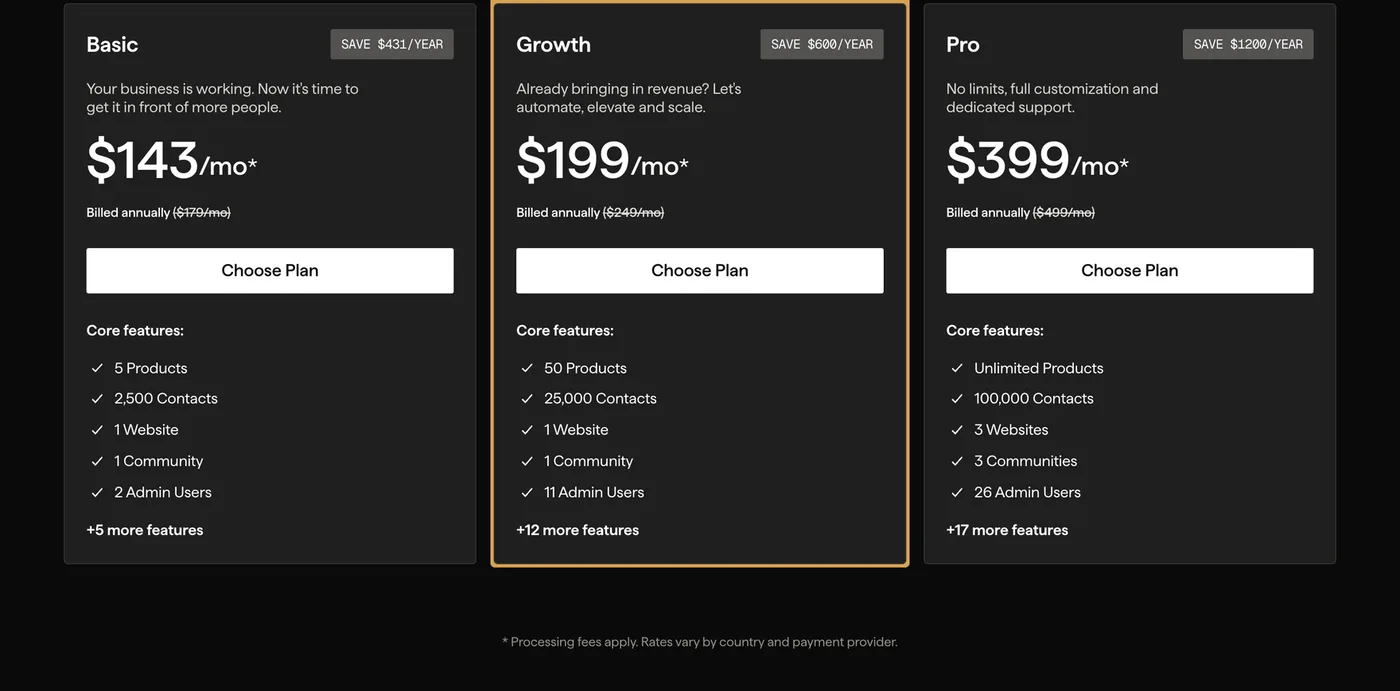
How we verified
We captured this directly from kajabi.com/pricing in August 2026 — not from an affiliate roundup. Prices shown are annual billing; month-to-month runs higher ($179/$249/$499). Kajabi Payments adds 0.7% on subscriptions and 1.5% on international cards. Pricing pages change, so we date every screenshot.
The net effect: Kajabi's cheapest option is now $143/month (annual billing), making it the most expensive entry point in the course platform market. Users on r/CourseCreation describe feeling locked in after building extensive email automations and funnels on the platform — making the switching cost significant even when the price climbs.
Product Limits: 5 Sounds Generous Until You Count
Kajabi's "products" include courses, coaching programs, digital downloads, podcasts, and memberships. The Basic plan's 5-product limit means you could hit the cap with three courses, one coaching program, and one downloadable resource. That pushes you to Growth at $249/month — a 44% price increase from Basic.
What Kajabi Users Say
What Users Appreciate
"It genuinely works as an all-in-one business platform. I honestly don't see the value in paying for 10-20 separate tools."
That consolidation benefit is the most consistently cited positive across reviews. Users on r/OnlineBusiness frequently note that the integrated analytics — seeing how email campaigns connect to course enrollments — provides insights they couldn't easily get with separate tools.
Common Complaints
"My plan when I started was around $149, now they want $249+ per month."
The 2025 price restructuring generated widespread backlash. Basic went from $149 to $179/month while contact limits were cut from 10,000 to 2,500. Users on r/CourseCreation describe feeling locked in after building extensive email automations and funnels on the platform, making the switching cost significant even when the price climbs.
"They removed the option to add subtitles manually just to force you to use their AI feature."
This pattern — removing existing features to push paid add-ons — frustrated long-time users. As of September 2026, Kajabi's help center again documents uploading your own .srt caption file. Automatic transcripts use AI credits: none are included on Basic, and extra credits cost $15/month per 500.
Course features also draw pointed criticism. Multiple G2 reviewers note that course tools feel limited compared to dedicated learning platforms — one described the course functionality as "incredibly limited" relative to everything else Kajabi offers. A Trustpilot reviewer in February 2026 described spending nearly three hours troubleshooting broken products and pages during a launch, with support unable to resolve the issue quickly.
The Migration Question
Who Should Use Kajabi (And Who Shouldn't)
Kajabi Is a Strong Choice If You:
- Want a true all-in-one platform — email marketing, sales funnels, landing pages, courses, and payments in one dashboard
- Would otherwise pay for 3-4 separate tools (ConvertKit + ClickFunnels + course platform) — Kajabi consolidates the cost
- Need professional page templates that look polished out of the box without a designer
- Run a marketing-heavy business where email sequences and funnels drive most of your revenue
- Are comfortable paying $143-$399/month for the convenience of everything in one place
Kajabi Is Not Ideal If You:
- Primarily need course hosting and already use tools like ConvertKit or Mailchimp for email — you'd pay $143+/month for features you don't use
- Want unlimited courses and students without product caps or contact limits — Kajabi caps at 5 products / 2,500 contacts on Basic
- Need cohort courses, affiliates, or advanced automations on a budget — these require the $199/month Growth plan
- Want to use your own Stripe account without a 0.5-2% surcharge
- Want live teaching on every Ruzuku plan with built-in browser meetings and optional Zoom integration — Kajabi also has native video in Coaching/Course Products, while its scheduled Cohort Courses require Growth or Pro
- Want student tech support handled for you — Kajabi supports you, not your students
The Hidden Cost: Kajabi Payments and Subscriber Lock-In
Kajabi pushes creators onto its proprietary payment processor (Kajabi Payments). If you use it, your subscription relationships are tied to the platform — not to your own Stripe account. Multiple long-term Trustpilot reviewers report that leaving Kajabi means losing all recurring subscription customers, because those payment relationships don't transfer. This isn't a data export problem — it's a recurring revenue problem. On Ruzuku, you connect your own Stripe account and own those relationships directly.
The Migration Question
Leaving Kajabi requires migrating your course content (re-uploading videos), exporting your email list (possible as CSV), and rebuilding your funnels and automations on separate tools. If you've invested heavily in Kajabi's page builder, those designs don't transfer. And if you used Kajabi Payments, your subscription customers may not come with you. Reddit users who've made the switch estimate 2-6 weeks for a complete migration, depending on complexity.
For a full feature-by-feature breakdown beyond pricing, see our complete Kajabi vs Ruzuku comparison and honest Kajabi review. You can also view Kajabi's official pricing page to verify current numbers.
Real-World Cost Scenarios
What Kajabi actually costs at three revenue levels — including fees, add-ons, and the plan you'd really need.
Solo Creator
$1,000/mo revenueKajabi
$143/mo
Basic: $143/mo
Annual: $1,716/yr
Ruzuku
$99/mo
Core ($99/mo): $99/mo
0% platform fee (standard Stripe 2.9% + $0.30)
Annual: $1,188/yr
What you get on Kajabi
- All-in-one platform (email, pages, courses)
- Custom domain + checkout pages
- AI features
What you'll still need
- Only 5 products
- No affiliate program
- No advanced automations
- No cohort courses
- No student tech support
Growing Business
$5,000/mo revenueKajabi
$199/mo
Growth: $199/mo
Annual: $2,388/yr
Ruzuku
$99/mo
Core ($99/mo): $99/mo
0% platform fee (standard Stripe 2.9% + $0.30)
Annual: $1,188/yr
What you get on Kajabi
- 50 products
- Affiliate program
- Advanced automations
- Cohort courses
- Built-in email marketing
- Remove branding
What you'll still need
- 25,000 contact cap
- No branded mobile app
- No API access
- No student tech support
Established Creator
$20,000/mo revenueKajabi
$399/mo
Pro: $399/mo
Annual: $4,788/yr
Ruzuku
$199/mo
Pro ($199/mo): $199/mo
0% platform fee (standard Stripe 2.9% + $0.30)
Annual: $2,388/yr
What you get on Kajabi
- Unlimited products
- 100,000 contacts
- 26 admin users
- Branded mobile app
- API access
- Custom code editor
- Built-in email and funnels
What you'll still need
- 100,000 contact cap (not unlimited)
- No student tech support
Kajabi vs. Ruzuku: Honest Comparison
A fair, side-by-side cost comparison focused on what matters most to course creators.
| Feature | Kajabi | Ruzuku |
|---|---|---|
| Starting price (annual) | $143/mo (Basic) | $83/mo (Core annual) |
| Payment processing | 2.9% + $0.30 (Kajabi Payments) | 2.9% + $0.30 (your Stripe) |
| 3rd-party processor surcharge | 0.5-2% on top of Stripe | None — use your own Stripe freely |
| Courses / products | 5 (Basic) to Unlimited (Pro) | Unlimited on all plans |
| Students | 2,500–100,000 contacts | Unlimited |
| Built-in email marketing | Yes, all plans | No (use Mailchimp, ConvertKit, etc.) |
| Sales funnels & landing pages | Yes, built-in | No (use separate tools) |
| Student tech support | Not included | Included on every plan, including Free |
| Live video sessions | Native Coaching/Course video; scheduled cohorts on Growth/Pro | Built-in video meetings + Zoom integration |
| Cohort / drip courses | Growth ($249/mo) and up | All paid plans |
Choose Kajabi if:
You want a true all-in-one platform that includes email marketing, sales funnels, and landing pages so you don't need to pay for separate tools. You value having everything in one dashboard and are comfortable with the premium price.
Choose Ruzuku if:
You want unlimited courses and students without product caps or contact limits, lower processing fees through your own Stripe account with no surcharges, built-in student tech support, and a simpler platform focused on teaching rather than marketing.
Kajabi Pricing FAQ
How much does Kajabi cost per month?
Kajabi has three plans: Basic at $179/month ($143/month billed annually), Growth at $249/month ($199/month annually), and Pro at $499/month ($399/month annually). There is no free plan or entry-level tier below $143/month.
Does Kajabi charge transaction fees?
Kajabi charges 0% platform transaction fees if you use Kajabi Payments, but the processing rate is more layered than reviews say. The base rate is 2.9% + 30¢ on Basic (dropping to 2.7% + 30¢ on Pro). But Kajabi's own help center confirms two surcharges most reviews miss: an additional 0.7% on every subscription or payment plan transaction, and an additional 1.5% on international cards. For a course business running on memberships, the real effective rate is 3.6% + 30¢ on Basic, not 2.9%. If you use your own Stripe or another third-party processor instead, Kajabi adds another surcharge: 2% on Basic, 1% on Growth, 0.5% on Pro. Buy Now, Pay Later via Afterpay or Klarna runs 6% + 30¢. Disputes cost $15 per chargeback regardless of outcome.
Is Kajabi worth it in 2026?
Kajabi is worth it if you need an all-in-one platform with built-in email marketing, landing pages, and sales funnels — and you want to avoid managing multiple tools. It's less worth it if you primarily need course hosting and already use tools like ConvertKit for email, since you'd be paying $143+/month for features you don't use.
What happened to Kajabi's Kickstarter plan?
Kajabi no longer offers the Kickstarter plan ($89/month) to new creators; it's gone from the public pricing page. Existing Kickstarter accounts kept their $89 price through the 2025 price increase, per Kajabi's own before-and-after comparison. For new creators, the cheapest Kajabi plan is now Basic at $179/month ($143/month billed annually), 61% above the old $89 entry price.
Which Kajabi features require the Growth or Pro plan?
On the Basic plan ($179/month), you cannot use affiliate programs, advanced automations, webhooks, cohort courses, or Comment-to-DM, and you cannot remove Kajabi branding. Those need Growth ($249/month). The branded mobile app, API access, and custom code editor require the Pro plan ($499/month). Video transcriptions and the universal inbox are included on Basic.
What counts as a product on Kajabi Basic?
Basic allows 5 products. Per Kajabi's help center, each course, coaching product, podcast, and newsletter counts as one product. All your downloads together take a single slot, however many you create. Communities don't count toward the limit.
What happens when you hit Kajabi Basic's 2,500-contact limit?
Kajabi warns you at 90% of your limit. At 100%, it emails you and gives you 30 days to delete contacts or upgrade. After that, you can only log in to Account Settings to upgrade, though your customers can still use your site and courses. Kajabi's pricing page says you can instead add contacts in blocks of 25,000 for $125/month, or move up to Growth (25,000 contacts, $249/month or $199/month billed annually).
Can I use my own Stripe with Kajabi?
Yes, but Kajabi charges an additional surcharge: 2% on Basic, 1% on Growth, 0.5% on Pro — on top of Stripe's standard 2.9% + $0.30. Using Kajabi Payments avoids this surcharge but locks you into their payment ecosystem.
What is Kajabi?
Kajabi is an all-in-one platform for selling online courses, memberships, coaching, and digital products. It includes built-in email marketing, sales funnels, landing pages, and a website builder — designed so creators can run their entire business from one dashboard without third-party tools.
Are Kajabi coupon codes legit?
Most Kajabi coupon codes found online are not legitimate. Third-party coupon sites list codes that are expired, fabricated, or simply affiliate referral links disguised as discounts. Kajabi does not distribute public promo codes. The only reliable savings are: annual billing (20% off), and occasional extended free trials through official partners.
What is the best way to get a discount on Kajabi?
The best way to save on Kajabi is to choose annual billing, which saves 20% on every plan (up to $1,200/year on Pro). Kajabi also runs occasional seasonal promotions like extended trial periods during Black Friday. If Kajabi's pricing is still too high, Ruzuku offers unlimited courses and students starting at $99/month with a permanent free tier to get started.
Does Kajabi offer a nonprofit discount?
No. Kajabi does not publish a nonprofit discount. 501(c)(3) nonprofits and educational programs pay standard commercial rates starting at $143/month (billed annually) for Basic, $199/month for Growth, and $399/month for Pro. In contrast, Ruzuku publishes a transparent 30% discount on annual plans ($1,398/year Pro = $116.50/mo), zero transaction fees, built-in live video meetings, and a one-time $4,950 Lifetime Pro grant license. For a full platform comparison, see our guide to nonprofit discounts on course platforms.