Short answer — Is Whop free? Yes upfront: there is no monthly subscription fee or upfront charge to create a store and list digital products on Whop. Instead, Whop monetizes by taking 2.7% + 30¢ (plus 10¢ in fraud screening) on every sale. At lower volumes, this pay-as-you-sell model is cheaper than a flat-rate platform. But as soon as you sell courses at volume or enable Whop's optional percentage layers (2% managed tax, 0.5% billing, Apple's 30% iOS cut), transaction drag compounds quickly. A flat-rate platform like Ruzuku ($99/mo with 0% transaction fees) becomes more economical at approximately $3,100 to $4,100 in monthly sales.
Is Whop free to use? What does Whop actually charge in 2026?
Take a fitness coach selling a $297 eight-week program to about 20 people a month — roughly $6,000 in sales. What Whop costs her depends entirely on which of its percentage layers her account is on, and most sellers have never been told which ones those are.
| If her Whop account is on… | Whop takes | Ruzuku Core at $99 | Cheaper |
|---|---|---|---|
| Base rate only, 2.7% + $0.40 | $172.58 (2.88%) | $279.06 | Whop, by $106 |
| Billing on, 3.2% + $0.40 | $202.58 (3.38%) | $279.06 | Whop, by $76 |
| Billing + managed tax, 5.2% + $0.40 | $322.58 (5.38%) | $279.06 | Ruzuku, by $44 |
| Everything on, 6.0% + $0.40 | $370.58 (6.18%) | $279.06 | Ruzuku, by $92 |
Same seller, same month, same $6,000. The spread between her cheapest case and her most expensive is $198 a month, and none of it appears on Whop's pricing page. She never gets a bill either way — it comes out before the payout lands, which is usually how somebody ends up reading a page like this one. Notice the top two rows while you're here: most articles in this category, including the version of this page that ran until today, will not tell you that Whop is the cheaper option for a seller her size.
Here's the whole rate card, read from Whop's pricing page and fee documentation on August 20, 2026.
| Fee | Amount | Whop's own wording |
|---|---|---|
| Cards and wallets | 2.7% + $0.30 | Per successful transaction for domestic cards |
| International cards | +1.5% | On top of the domestic rate |
| Currency conversion | +1% | If currency conversion applies |
| ACH direct debit | 1.5%, capped at $5 | Per successful ACH debit transaction |
| Financing (Klarna, Afterpay and others) | 15% | Per successful transaction through a financing partner |
| Radar fraud screening | $0.07 | Per transaction |
| 3D Secure authentication | $0.03 | Per transaction |
| Payment orchestration | 0.8% | Per transaction (when enabled) |
| Billing automation | 0.5% | Per transaction. No condition stated |
| Tax and remittance | 2% | Per transaction with tax collection |
| Affiliate processing | 1.25% | Per transaction, on top of the commission itself |
| Payout, next-day ACH | $2.50 | Per successful payout |
| Payout, instant bank deposit | 4% + $1.00 | Per successful payout |
| Payout, crypto or Venmo | 5% + $1.00 | Per successful payout |
| Payout, bank wire | $23.00 | Per successful payout, 1–2 business days in the US |
| Dispute | $15.00 | Flat fee when a chargeback or dispute occurs |
| Early dispute alert (RDR) | $29.00 | Per alert |
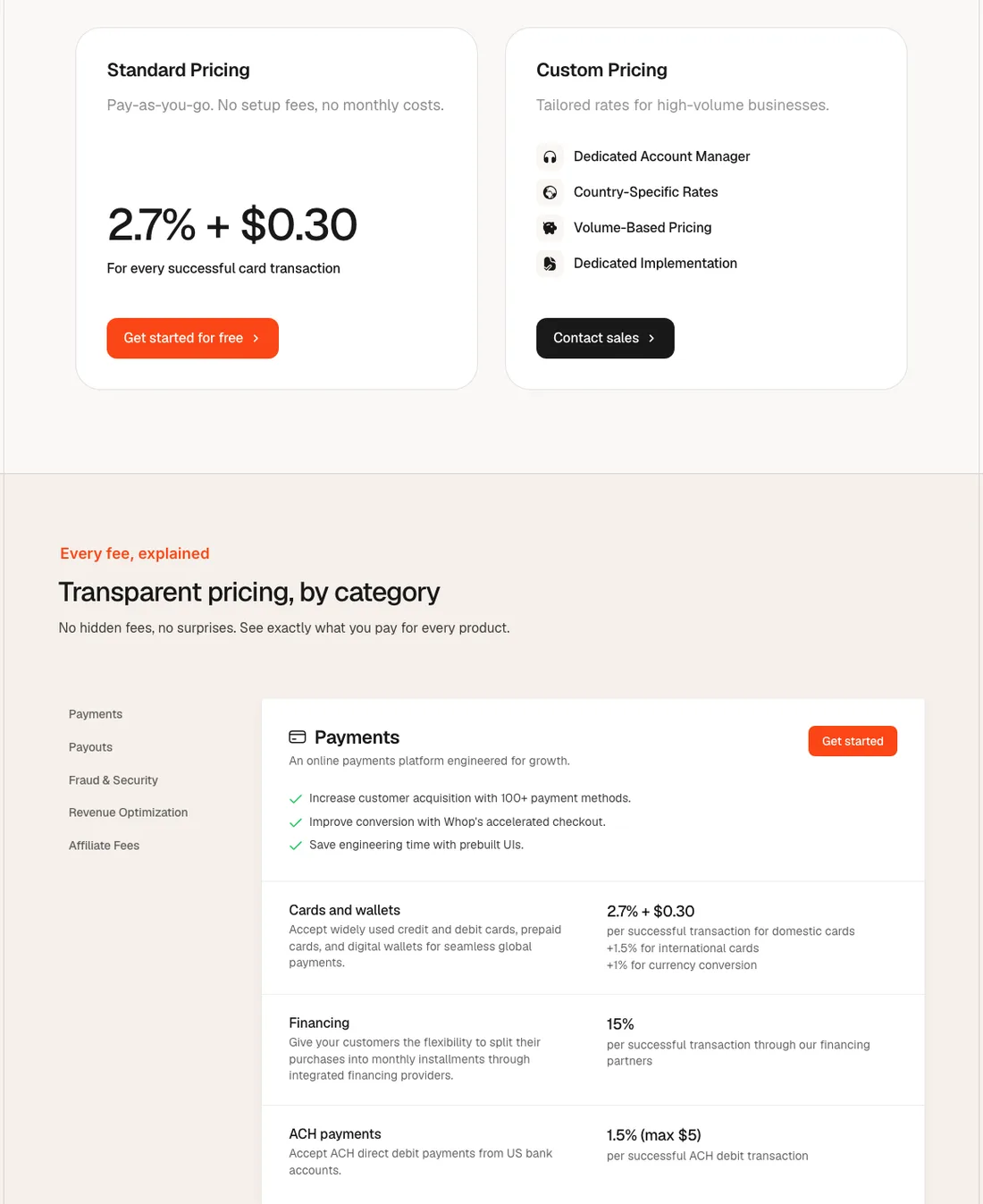
How we verified
We captured this directly from whop.com/network/pricing/ in August 2026 — not from an affiliate roundup. The same page headlines 'No hidden fees, no surprises' above these categories. That's fair as far as it goes — every fee on this page came from Whop publishing it. What the page can't tell you is which of these lines are yours. Pricing pages change, so we date every screenshot.
Give Whop credit here: it publishes more of its rate card than most platforms do, on a page a buyer can read, and it says so in plain language. The problem for a course seller isn't concealment. It's that nothing on that page tells you which of those seventeen lines apply to someone selling an eight-week program to twenty people a month, and the answer turns out to matter more than the headline rate does.
Why was my Whop payout smaller than I expected?
Most people searching for Whop's fees have just looked at a payout and done a double take. So before the platform comparison, here's the diagnostic. This is what one $297 sale nets you, by cause. Find the row that matches and you have your answer.
| What happened on that sale | You net | Cost of the sale |
|---|---|---|
| Nothing unusual — base rate, card, US buyer | $288.58 | 2.8% |
| Whop's billing and managed tax layers are on | $281.16 | 5.3% |
| Buyer paid with Klarna, Afterpay or another financing partner | $244.03 | 17.8% |
| Sale arrived through an affiliate link at Whop's 30% default | $195.77 | 34.1% |
| Buyer bought inside the Whop iOS app | $297.00 | 0% to you — Whop marks the price up 42.86% and your buyer pays it |
| Buyer disputed the charge | −$15.00 | The sale reverses and the $15 fee stands |
Two more things shrink a payout without touching any per-sale rate. A next-day ACH payout costs $2.50 every time you move money, and 4% + $1.00 if you take it instantly — small, but it multiplies if you withdraw weekly. And Whop can hold part of your balance in reserve. If you sell seats in a program that starts later, read the reserve section before anything else on this page; Whop's own policy names your business model as a trigger.
Each of those rows is worked through further down: financing and iOS in the Klarna and iPhone section, the affiliate default in the marketplace section, and reserves in the payout section.
Does Whop charge a platform fee?
No. As of August 20, 2026, Whop's published fee schedule carries no platform fee. The 3% that used to sit on top of card processing is gone, and what you pay now is 2.7% + 30¢ per transaction plus whichever optional percentage layers your account is on. Whop's rate card dropped that 3% between December 11, 2025 and February 15, 2026, with no changelog entry and no announcement.
I'll take our own error before somebody else's. Until today this page told you Whop charged a 3% platform fee on sales with Discord, Telegram or TradingView gating, bringing the base rate to 5.7% + 30¢. That was wrong when we published it in March 2026, and it's the number our meta description led with.
Here's what the archive shows for Whop's fee page.
| Archived snapshot | Platform fee | Card processing | Marketplace commission |
|---|---|---|---|
| January 14, 2025 | 3% | 2.9% + $0.30 | 30% |
| September 12, 2025 | 3%, on purchases with automations | 2.7% + $0.30 | Gone |
| December 11, 2025 | 3% | 2.7% + $0.30 | Gone |
| February 15, 2026 | Gone | 2.7% + $0.30 | Gone |
| August 20, 2026 (live) | Gone | 2.7% + $0.30 | Gone |
Two things fall out of that table. The card rate itself moved from 2.9% to 2.7% somewhere in 2025, which several pages ranking for "whop fees" still have wrong. And our sentence about Discord and TradingView gating was almost word for word Whop's own September 2025 wording, which tells you exactly when the research was done and that nobody re-checked it before publishing. If you take one process lesson from this page, take that one: pull the source again on the day you publish.
Be precise about what "gone" means. Whop's published fee schedule no longer lists a 3% platform fee, and grepping both the pricing page and the fee docs for "3%" and "platform fee" returns nothing at all. Whop's API reference still carries fee machinery with names like application fee and revenue-share percentage fee, but none of those has a published rate attached to it. What replaced the flat 3%, as a practical matter, is a set of percentage layers on the same rate card.
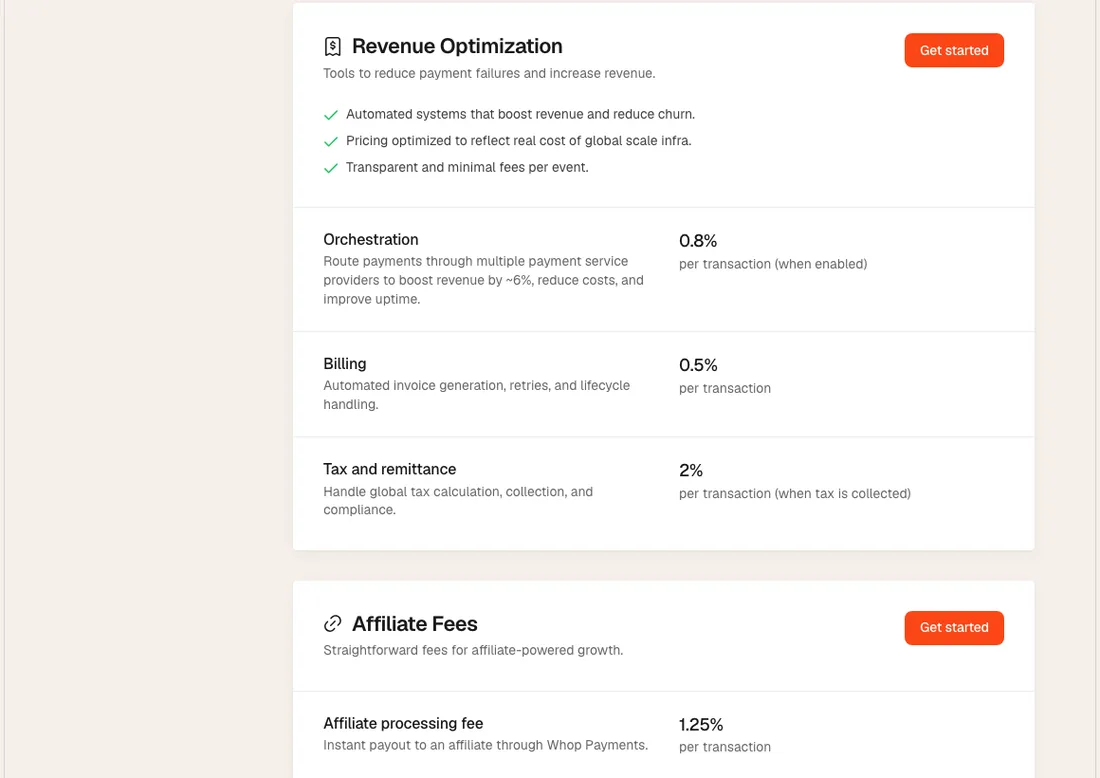
How we verified
We captured this directly from whop.com/network/pricing/ in August 2026 — not from an affiliate roundup. Orchestration is marked '(when enabled)' and tax is marked '(when tax is collected)'. Billing carries no qualifier. Pricing pages change, so we date every screenshot.
Which of those fees will you actually pay?
Three of the percentage layers stack, and whether you're on them changes the answer to every other question on this page. So price all three cases rather than pretending there's one Whop rate.
- Direct sales only, 2.7% + $0.40. You sell a one-time course through a checkout link, you handle your own sales tax, and you leave orchestration off. This is the cheapest Whop can be.
- Billing and tax on, 5.2% + $0.40. You use Whop's managed tax handling and you're paying the 0.5% billing line. This is where I'd expect a US seller with subscription or payment-plan pricing to land.
- Everything on, 6.0% + $0.40. Add payment orchestration at 0.8%. Whop's own pitch for it is that routing through multiple processors lifts revenue by around 6%, so turning it on can pay for itself. It still shows up in your fee line.
The 0.5% billing line is the one I can't resolve for you from public sources, and I'd rather say so than guess. Whop marks orchestration "(when enabled)" and tax "(when tax is collected)". Billing carries no qualifier at all: it reads "0.5% per transaction," full stop. That could mean it applies to every charge, or it could mean the qualifier is missing. Whop's documentation doesn't say. The tables below price both cases, and if you sell on Whop today the fastest way to settle it is to open one payment in your dashboard and read the fee breakdown on it.
Independently, Forbes reported in April 2026 that Whop's blended take rate across its whole business runs about 5.5%, which the company describes as covering transaction processing, fraud detection, billing automation and payout fees. That's a different measurement from anything in this article, but it lands in the same neighborhood as the middle case rather than the headline 2.7%.
What Whop costs at $1,000, $5,000, and $20,000 a month
Percentages are hard to feel. Dollars aren't. Both tables show the same nine scenarios, with the arithmetic in the open so you can check it against your own price. The Ruzuku column is Core at $99 a month with your own Stripe account, which charges 2.9% + $0.30 — two tenths of a point more than Whop on the percentage and ten cents less on the flat charge. Those cross at a $50 sale. Above $50 a sale, Whop's processing is the cheaper of the two.
Direct sales at Whop's base rate: 2.7% + $0.40
| Gross/mo (base rate, 2.7%) | Price | Sales | Whop total | Ruzuku Core total | Cheaper by |
|---|---|---|---|---|---|
| $1,000 | $47/mo subscription | 21 | $38.01 (3.80%) | $134.38 (13.44%) | Whop, $96 |
| $1,000 | $297 | 3.4 | $30.85 (3.08%) | $129.01 (12.90%) | Whop, $98 |
| $1,000 | $997 | 1 | $29.90 (2.99%) | $128.30 (12.83%) | Whop, $98 |
| $5,000 | $47/mo subscription | 106 | $180.05 (3.60%) | $275.91 (5.52%) | Whop, $96 |
| $5,000 | $297 | 16.8 | $144.23 (2.88%) | $249.05 (4.98%) | Whop, $105 |
| $5,000 | $997 | 5 | $139.51 (2.79%) | $245.50 (4.91%) | Whop, $106 |
| $20,000 | $47/mo subscription | 426 | $712.71 (3.56%) | $806.66 (4.03%) | Whop, $94 |
| $20,000 | $297 | 67 | $569.44 (2.85%) | $699.20 (3.50%) | Whop, $130 |
| $20,000 | $997 | 20 | $550.52 (2.75%) | $685.02 (3.43%) | Whop, $134 |
Read that table before anything else on this page, because it says the opposite of what a course platform's blog is supposed to say. Whop is cheaper in all nine cells, and the gap gets wider as revenue grows rather than closing. That's not a rounding artifact. Whop's percentage is below Stripe's published rate, so the $99 has nothing to claw back.
With billing and managed tax on: 5.2% + $0.40
| Gross/mo (billing + tax, 5.2%) | Price | Whop total | Ruzuku Core total | Cheaper by |
|---|---|---|---|---|
| $1,000 | $297 | $55.85 (5.58%) | $129.01 (12.90%) | Whop, $73 |
| $5,000 | $47/mo subscription | $305.05 (6.10%) | $275.91 (5.52%) | Ruzuku, $29 |
| $5,000 | $297 | $269.23 (5.38%) | $249.05 (4.98%) | Ruzuku, $20 |
| $5,000 | $997 | $264.51 (5.29%) | $245.50 (4.91%) | Ruzuku, $19 |
| $20,000 | $297 | $1,069.44 (5.35%) | $699.20 (3.50%) | Ruzuku, $370 |
Whop total = the stack rate × gross, plus $0.40 per sale (30¢ card, 7¢ Radar, 3¢ 3DS), plus one $2.50 next-day ACH payout a month. Ruzuku Core total = $99 + 2.9% of gross + 30¢ per sale, paid to Stripe rather than to us. Both assume US cards, USD, no currency conversion, no financing, no disputes and no reserve.
Turn payment orchestration on as well, at 6.0% + $0.40, and the middle row moves from $269.23 to $309.23 while our column doesn't move at all. At $20,000 a month on $297 sales it's $1,229.44 against $699.20.
At what revenue does a flat fee get cheaper?
Set the two costs equal and solve. Processing does not cancel out here, which is what makes Whop different from Patreon's 10% — there, both sides pay Stripe the same rate and it drops out of the equation.
Ruzuku Core - Whop = 96.50 + G × (0.002 - 0.10/P)

  G = gross revenue per month
  P = price per sale
  96.50 = the $99 plan minus Whop's $2.50 payout fee
That expression stays positive — meaning Whop stays cheaper — whenever P is $50 or more. So on Whop's base rate alone there is no crossover at all for any course priced above about $50. Not at $5,000 a month, not at $20,000, not at $200,000. A flat $99 never catches up, and any article telling you it does at $1,500 a month (including ours, until today) is describing a fee that Whop no longer charges.
Once the percentage layers are on, a line appears:
| Whop stack | $47/mo sub | $97 | $297 | $997 |
|---|---|---|---|---|
| Base rate only, 2.7% | No crossover. Whop stays cheaper at every revenue level | |||
| Billing + tax, 5.2% | $3,840/mo | $4,016/mo | $4,135/mo | $4,177/mo |
| Everything on, 6.0% | $2,913/mo | $3,013/mo | $3,079/mo | $3,103/mo |
Round it to about $4,100 a month on the realistic middle stack, and about $3,100 with everything switched on. Notice how flat that line is across price points: from a $47 subscription to a $997 course it moves less than 10%. Once you're paying percentage layers, what decides this is your monthly gross, not what you charge.
Three things move the line, and leaving any of them out would make the number dishonest.
Certificates move it a long way up, and this one goes against us. Whop includes PDF completion certificates at $0 a month. On Ruzuku, certificates are a Pro feature at $199 a month, along with custom domains, white-label branding and multiple instructor accounts. If a certificate is why you're reading this, Whop wins that line outright, and the break-even against Pro at a $297 price is about $8,400 a month rather than $4,100.
Annual billing moves it down. Core billed yearly is $997, which works out to $83.08 a month and pulls the middle-stack line to roughly $3,450. Worth knowing; not worth building a decision on until you're past the monthly line anyway.
Our free plan moves it to zero. If you're under the line, the honest answer isn't "pay $99," it's "run a pilot for nothing." Ruzuku's free plan carries unlimited courses with up to 5 students at a time, which is the wrong size for a business and the right size for a test.
If your prices are messier than $297 and $997, run your own numbers in the course platform cost calculator.
What happens when someone pays with Klarna, or buys in the iPhone app?
These two events cost a course seller more than the entire base-rate argument, and neither is on any competing page I could find.
Buy now, pay later costs 15%. Whop's fee page lists financing at "15% per successful transaction through a financing partner," and its pricing page shows ten of them, Klarna and Afterpay among them. A $997 course bought on an installment plan costs $149.55 in financing plus $27.32 in processing: $176.87, or 17.7% of the sale. High-ticket course buyers reach for these buttons constantly, and the difference between a 2.7% sale and a 17.7% sale is entirely the buyer's choice at checkout, not yours.
iPhone buyers cost 30%, paid by them. Apple processes every one-time purchase under USD 700 made inside the Whop iOS app and takes 30%. Whop's response is documented plainly: it "automatically increases the price of one-time products under USD 700 on the iOS app only," marking the product up by 42.86% to offset Apple's cut. So your $297 course shows as $424.29 to someone browsing in the app, and a $97 course shows as $138.57. You net the original price. Your buyer pays the markup, or closes the app.
Two details make it worse for courses specifically. Apple remits to Whop "up to 75 days after the transaction date," so that money sits pending while you're delivering the program. And subscriptions and one-time purchases at $700 or more skip Apple entirely, which means the products this hits hardest are exactly the ones most course sellers offer: a single payment, under $700.
Is the Whop marketplace really 0% commission?
Listing is 0%, and that's real. Whop removed its 30% marketplace commission in May 2025, which Forbes confirmed in its April 2026 profile of the company. Every page that still quotes 30% is out of date.
The part nobody has written up is what Whop switches on alongside it. From Whop's own affiliate documentation: "After you list your product, any affiliate in Whop's network can promote it for a default 30% commission without extra setup." You can change that rate to anything you like, and Whop says so on the same page. The default is 30%.
Here's a $297 course sale that arrives through an affiliate link:
| Line | Amount |
|---|---|
| Affiliate commission, default 30% | $89.10 |
| Affiliate processing, 1.25% | $3.71 |
| Card processing, 2.7% + $0.40 | $8.42 |
| Total cost of the sale | $101.23, or 34.1% |
| You keep | $195.77 |
Both statements are true at once: the marketplace charges 0% commission, and the default commission on a marketplace-driven sale is 30%. A buyer who browses Discover and buys on their own isn't an affiliate sale and doesn't trigger any of it. Whop also documents a 30-day waiting period between the purchase and the affiliate getting paid, which is a cash-flow detail worth knowing if you plan to lean on this channel. Check your global affiliate rate on the day you list, and set it deliberately.
What can you actually build in Whop's Courses app?
More than our previous version of this page gave it credit for, and I'd rather correct that than leave a competitor understated. Whop publishes an API reference for its Courses app, which is the closest thing to a specification either of us offers, and it settles most of these questions field by field.
| Capability | Whop | Ruzuku |
|---|---|---|
| Course structure | Modules, chapters, lessons | Modules and lessons, reorderable |
| Lesson types | Six: text, video, PDF, multimedia, quiz, knowledge check | Text, video, audio, files, embeds |
| Quiz question types | Four: short answer, true/false, multiple choice, multiple select | Multiple choice, short answer, essay, with instructor feedback |
| Sequential gating | Yes — "require lesson completion" toggle | Yes |
| Completion certificates | Yes, PDF, included at $0/month | Yes, PDF, customizable — Pro plan at $199/mo |
| Drip by enrollment date | Yes, in days after a student starts | Yes |
| Cohort start dates | No absolute-date field on the course or lesson object | Yes — scheduled delivery gating on real calendar dates |
| Discussion attached to a lesson | No. Chat and Forums are separate apps | Threads at course and module level, with instructor moderation |
| Assignment submission | No submission lesson type. Whop suggests a chat channel | File upload with instructor feedback |
| Per-student progress data | Lessons completed, completion rate, first and last interaction. No time-on-lesson, no drop-off point | Lesson-level completion and engagement per student |
| CSV export | Members, memberships, people, receipts and more — but no course progress export | CSV export of student and account data |
| Live sessions | Events app | Built-in video meetings with no Zoom account needed (60 in conference mode, 250 in presentation mode), plus a Zoom integration for breakout rooms |
| Native mobile app for students | Yes, iOS and Android | No native app — mobile web and PWA install |
| Cost model | Percentage of every sale, no fixed cost | Flat monthly fee, 0% platform fee |
The rows in red are the ones that survive scrutiny, and they cluster. Whop can release lesson four on a student's day fourteen; it has no field anywhere that opens a course to everyone on March 3rd. Its lesson object has no comment or thread on it, so a question about lesson four goes into a chat channel where it scrolls away. There's no assignment type, and Whop's own course playbook suggests a chat channel for "assignment submissions" instead, which works until you want to know who submitted. And progress lives behind the API, so if you want a spreadsheet of who finished, you or someone you pay is writing code.
None of that makes Whop bad software. It makes it software built for a community you keep people inside, adapted to hold a course, which is a different job from teaching a group of people the same thing at the same time.
Does a marketplace or a cohort fit what you're teaching?
This is the question underneath the fee schedule, and we can measure one side of it directly. In August 2026 we pulled completion rates across 26,632 courses and 1.3 million enrollments on Ruzuku, using the platform's own binary completion record rather than anything self-reported. Every rate below is an average over enrollments unless the bullet says otherwise.
These are observational associations across creators who chose their own formats, not a controlled trial. Creators who run scheduled cohorts are probably more hands-on to begin with, and that shows up in the numbers alongside the format itself. The cohort-size finding is the one I'd take most seriously anyway, because it points the opposite way from how a marketplace helps you: a marketplace's job is to send you volume, and volume is the shape that finishes least.
One counterweight, since the fee tables above lean on $297 and $997 courses. On our own platform, 37.6% of listed price options are free, and most of the paid ones sit well below $297. Our creators price low too. Moving to a flat fee doesn't automatically let you charge more.
For what it looks like when someone builds the ladder rather than picking a side, Dr. Ken Long teaches trading, creativity and storytelling from one Ruzuku tenant: free artifacts, then mini courses, then self-paced foundations, then cohort coaching, then one-to-one advising. More than 100 published courses, 17,000-plus lesson completions, 620-plus students averaging about three courses each. Trading education is Whop's home turf; Ken has never mentioned Whop to us, and he's on a lifetime Pro plan rather than the $99 Core the tables above price, so read him as an example of the shape rather than of the cost.
Who should stay on Whop?
Most articles in this category conclude "switch," and the math above says that's wrong for a large group of people. So here's the group, with thresholds attached instead of adjectives. Stay on Whop if these are true together:
- You're under about $4,000 a month and you're not using Whop's managed tax handling. Below that line, on the base rate, Whop costs less than $99 a month and a flat fee is simply worse. If you're on the base rate alone with courses priced above $50, that stays true at any revenue.
- Your buyers already live on Whop — they arrive through Discover or a Discord you already run — and you can name roughly what share of sales that is. Discovery is the thing you're paying the percentage for, so the number matters. If you can't say what fraction of last month's sales came from Whop's own traffic rather than from your list, your server or your own posting, that's the first thing to go find out. It's the whole case for paying a percentage, and most sellers have never checked it.
- Your product is a community that a course supports, not a course that a community supports. Trading rooms, sports picks, reselling groups and Discord servers are what Whop was built around, and by revenue they're still where its weight sits. Whop's course tooling is a good bonus layer on that, and it's free.
- Your Discord is the product and Whop is what gates it. A lot of people are on Whop for exactly one reason: a paid membership grants a Discord role automatically, and that automation is why they never went looking. If that describes you, keep it. We don't integrate with Discord, and a course platform doesn't replace three years of a server you built. What's worth separating is the two questions — where the community lives, and where the eight-week program with a start date lives. They don't have to have the same answer, and the fee math above only applies to the second one.
- You need completion certificates and you're under about $8,400 a month. Whop gives them away; we charge $199 a month for them. That's the cleanest single line where Whop beats us and I'm not going to dress it up.
- Your material is finished and people work through it alone. Whop's drip does this properly: lesson four opens on a student's day fourteen, whenever they started, and nobody has to be in the same place at the same time. Everything in this article that argues for us assumes the opposite — that your people move through the material together, on dates. If they don't, the argument isn't about you.
One thing I should say plainly, because it cuts against our own credibility to hide it: nobody has ever written to our support team about leaving Whop. We searched two years of conversations across every mailbox and found a single mention, in an unrelated newsletter. So this page is built on Whop's documentation and our own platform data, not on customers who moved. Anyone claiming a stream of Whop refugees is telling you about their marketing, not their inbox.
When does Whop decide when you get paid?
This has nothing to do with percentages and it's the difference that would matter most to me. On Whop Payments, Whop is the merchant of record. The money is Whop's until Whop sends it to you, and Whop documents its reserve policy clearly: a rolling reserve holds a percentage of each sale for a set number of days, and a fixed-amount reserve holds a specific dollar figure out of your existing balance.
Two of Whop's own listed triggers describe a course seller almost exactly. The first is that "your account is new, or doesn't have much sales history yet." The second is worth quoting in full, because it's a better description of cohort enrollment than anything I could write:
"Customers pay you well before you deliver (pre-orders, bookings, or services delivered over months), so payments stay disputable long after the sale."
That's selling seats in a program that starts in six weeks and runs for eight. Whop isn't being unreasonable here; reserves are ordinary practice for a payment facilitator, and Whop explains them better than most. But it means enrollment revenue can sit behind a hold at exactly the moment you're paying for the delivery.
The rest of the picture, all from Whop's docs: standard payouts take up to five business days; a disputed amount is withdrawn from your balance immediately, along with a $15 fee, and you have 7 to 21 days to respond while the bank takes two to three months to decide; early dispute alerts cost $29 each; and while payment controls are active, an additional high-risk processing fee applies to card transactions. The line the card networks care about, per Whop, is a 1.5% dispute rate.
On a flat-fee platform like ours the arrangement is different in kind, not degree. Your students pay your Stripe or PayPal account. Stripe's payout schedule is the only one involved, and we never touch the money, which also means we can't hold it. If you want the full survey of fee mechanics that don't appear on pricing pages, the fees platforms don't put on their pricing pages is the companion piece to this one.
So which one fits your course?
Under about $4,100 a month with Whop's billing and tax layers on, or at any revenue on the base rate alone with a course priced above $50, Whop costs you less than we do and I'd stop reading here. Above that line the percentage keeps scaling and a flat fee doesn't: at $20,000 a month on $297 sales it's $1,069 against $699, which is $4,400 a year.
Cost is rarely what decides it, though. The question underneath is whether your material has a start date. If people are asking when the next round opens, if you want to know who stalled at lesson four, if somebody has to submit work and get it back with comments on it, you've outgrown a percentage question and no rate card changes that. If you're running a community and a course is the bonus inside it, Whop built exactly that, and it hands you certificates and an app store for nothing.
It doesn't have to be either. Whop's own course playbook tells you to install four apps around a course, and if a Discord you already run is where your people live, none of this argues for moving it. A marketplace that finds you buyers and a server that holds them are not things you abandon to run one cohort somewhere with a start date on it. Pricing the program is its own problem once you're off a percentage: our course pricing guide works through it with the same platform data behind it, and the course platform pricing comparison has the flat-fee options side by side, including Skool at $99 a month, which charges 2.9% + 30¢ on sales up to $899 and 3.9% + 30¢ above that.
If you opened that one payment at the top of this page and found yourself on 5.2% or 6.0%, here's what it costs at $6,000 a month on $297 sales: about $44 to $92 more per month than a flat $99 would be. Call it $500 to $1,100 a year at today's size, before you grow. That's real money and it still isn't, on its own, a reason to move anything. The reason to run a test is the other thing.
If you want to see what a start date does to a group before you decide anything, you can set up a free Ruzuku account and build a course in an afternoon. The free plan caps you at 5 students at a time, which is the right size for a test: pick five people who bought from you on Whop, run one short cohort with a real start date, and count how many finish. Your Whop keeps running the whole time. No credit card, and a person answers the support email.
Common questions about Whop's fees
How much does Whop take from a sale in 2026?
Whop charges 2.7% + $0.30 per successful domestic card transaction, with no monthly fee. Add $0.07 for Radar fraud screening and $0.03 for 3D Secure, both listed per transaction, and the working base rate is 2.7% + $0.40. International cards add 1.5%, currency conversion adds another 1%, and a next-day ACH payout costs $2.50. On top of that Whop publishes four percentage add-ons that many sellers end up on: 0.8% payment orchestration, 0.5% billing, 2% managed tax handling, and 1.25% affiliate processing. Read from Whop's fee documentation on August 20, 2026.
Does Whop still charge a 3% platform fee?
No. Whop's published fee schedule no longer lists a 3% platform fee. Archived copies of the same page show the fee present on December 11, 2025 and gone by February 15, 2026, and Whop never announced the change. The old wording tied the 3% to purchases with Discord, Telegram or TradingView automations. Our own earlier version of this page repeated it, which was wrong. What replaced it is a set of separately priced percentage layers on the same rate card.
At what monthly revenue does a flat-fee course platform cost less than Whop?
About $4,100 a month, if you're using Whop's billing and managed tax layers. That's where Ruzuku Core at $99 a month stops costing more than Whop's roughly 5.2% + $0.40 per sale. Turn on payment orchestration too and the line drops to about $3,100 a month. On Whop's base rate alone, with none of the optional layers, there's no crossover at all for any course priced above about $50 — Whop stays cheaper at every revenue level, and the gap widens as you grow. If you need completion certificates you're comparing against Ruzuku Pro at $199 a month, and the line moves to about $8,400.
Is the Whop marketplace really 0% commission?
Listing is 0%. Whop removed its 30% marketplace commission in May 2025. But Whop's affiliate documentation says that after you list a product, any affiliate in its network can promote it for a default 30% commission without extra setup, and you can change that rate to whatever you want. So one $297 course sale that arrives through an affiliate link costs $89.10 in commission, $3.71 in affiliate processing, and $8.42 in card processing — $101.23, or 34.1%. A buyer who browses Discover and buys on their own isn't an affiliate sale and doesn't trigger it.
How much extra does an iPhone buyer cost me on Whop?
Apple processes every one-time purchase under USD 700 made inside the Whop iOS app and takes 30%. Whop's response is to raise the price on iOS only, by 42.86%, so your take stays level: a $297 course shows as $424.29 in the app, and a $97 course shows as $138.57. You net the original price; the buyer either pays the markup or leaves and buys on the web. Apple remits to Whop up to 75 days after the transaction, and the payment sits pending until then. Subscriptions and one-time purchases at $700 or more skip Apple entirely.
Can you run a real course on Whop — quizzes, certificates, drip?
Yes, more than most articles admit. Whop's public API reference shows six lesson types (text, video, PDF, multimedia, quiz, knowledge check), four question types (short answer, true/false, multiple choice, multiple select), sequential gating through a require-lesson-completion flag, PDF completion certificates, and drip scheduling in days after a student starts. What's missing is cohort delivery: there's no absolute-date field anywhere on the Course or Course Lesson object, no discussion attached to a lesson, no assignment submission type, no time-on-lesson or drop-off analytics, and no CSV export of course progress.
Why does Whop hold part of my balance?
Because Whop is the merchant of record on Whop Payments, so it carries the chargeback risk and can hold funds against it. Whop documents two kinds of reserve: a rolling reserve that keeps a percentage of each sale for a set number of days, and a fixed-amount reserve taken from your existing balance. Two of its listed triggers hit course sellers directly — a new account without much sales history, and, in Whop's words, customers who "pay you well before you deliver (pre-orders, bookings, or services delivered over months), so payments stay disputable long after the sale." That's a description of selling seats in a cohort that starts next month.
Related resources
- How Ruzuku works — what scheduled course delivery looks like in practice
- Interactive Course Pricing & Fee Calculator — compare percentage fees against flat plans at your exact revenue
- Course Idea Validator — evaluate market demand and student completion potential for your offer
- Course platform pricing comparison — side-by-side pricing for 14 platforms
- Patreon fees for creators who also teach — a 10% cut instead of a fee stack, and where the line falls
- How to price your online course — what the platform data says about pricing a program