Short answer: Substack is a good place to grow a readership and a poor place to run a cohort, and most teachers end up doing both. The cost side: Substack takes 10% of every paid subscription, and Stripe takes 2.9% + 30¢ plus a 0.7% recurring billing fee on top, which is 17.4% of gross on an $8 monthly plan and 14.2% on a $50 annual one. That stops being the cheaper option at about $990 a month in subscription revenue, or 124 subscribers at $8 a month. The more useful number is smaller: a 100-subscriber Substack at $50 a year is the same money as 17 seats in a $297 cohort.
What does it look like to grow on Substack and still teach a cohort?
Say you're a nutrition coach with 900 free subscribers and 60 paying $7 a month. Your Substack costs you about $75 a month in fees, which is $901 a year, or 17.9% of gross. A little worse than the $8 tier in the table below, because Stripe's flat 30¢ is a bigger bite out of $7. For that you get a publishing habit, an inbox relationship with 900 people, and a recommendation network that keeps adding a few readers a week without you doing anything. That's working. Nothing on this page argues you should switch it off.
Now you want to run a six-week group program. That's a different job, and it's where the newsletter stops helping. Your paid archive unlocks all at once, so there's no week one. Everyone who joined last March is at a different place than everyone who joined last week, and you have no way to know which is which. You can't take a single $297 payment. You can't see who finished anything, because nothing records a finish.
The arithmetic on the second job is smaller than most people expect. Those 60 subscribers at $7 gross $5,040 a year. At $297 a seat, that's 17 people. Seventeen is a cohort you can actually teach, and as you'll see below, it sits right inside the group size where our completion data peaks. The rest of this page works through the cost of each side, what a "course" mechanically is inside Substack, and the point where staying put stops being the cheaper answer.
Substack Pricing & Fees: What Does Substack Actually Cost a Teacher?
Publishing on Substack is free at any list size. You pay only when readers pay you, and then three fees stack. Here's each one, read from Substack's own fee page on August 20, 2026.
| Fee | Amount | When it applies |
|---|---|---|
| Substack platform fee | 10% of each transaction | Every paid subscription payment |
| Stripe card processing | 2.9% + $0.30 per payment | Every card charge, US card in USD |
| Stripe recurring billing | 0.7% of billing volume | Every renewal. The 0.5% rate for creators who connected Stripe before July 10, 2024 expired on June 30, 2025 |
| Custom domain | $50, one time | Optional. No sales tax or VAT is charged on it |
| Apple App Store fee | 15% to 30% | Subscriptions bought inside the Substack iOS app |
| European bank payment methods | iDEAL 80¢, Bancontact and Sofort 1.4% + 30¢, SEPA Direct 0.8% + 30¢ capped at $6 | Stripe's rates for a US Stripe account. Failed SEPA debits cost $10 |
One thing to flag before the math, because Substack's documentation disagrees with itself today: one help article gives Stripe's recurring billing fee as 0.7%, another still says 0.5%. Stripe's own Billing pricing page says 0.7% of billing volume, so that's what the tables use. Substack's minimum prices are similarly split between two articles: the two most recently edited both say $5 a month and $30 a year on US-dollar Stripe accounts, and an older one says $50 a year. I'd trust the recent pair.
$8 a month, paid monthly
Per payment, Substack takes 80¢ and Stripe takes 58.8¢ (23.2¢ on the percentage, the flat 30¢, and 5.6¢ of billing fee). That's $1.39 of every $8, or 17.35% of gross. You keep $6.61.
| Paid subscribers | Gross per month | Substack 10% | Stripe | Total fees per month | Fees per year |
|---|---|---|---|---|---|
| 100 | $800 | $80.00 | $58.80 | $138.80 (17.35%) | $1,665.60 |
| 500 | $4,000 | $400.00 | $294.00 | $694.00 (17.35%) | $8,328.00 |
| 2,000 | $16,000 | $1,600.00 | $1,176.00 | $2,776.00 (17.35%) | $33,312.00 |
$50 a year, paid annually
Per payment, Substack takes $5 and Stripe takes $2.10. That's $7.10 of every $50, or 14.2%. Same business, same subscribers, 3.15 points cheaper, entirely because twelve 30¢ flat fees collapse into one. If you're on Substack and you don't offer an annual price, that's free money you're leaving on the table whether or not you ever read another word we write.
| Paid subscribers | Gross per year | Substack 10% | Stripe | Total fees per year | You keep |
|---|---|---|---|---|---|
| 100 | $5,000 | $500.00 | $210.00 | $710.00 (14.2%) | $4,290.00 |
| 500 | $25,000 | $2,500.00 | $1,050.00 | $3,550.00 (14.2%) | $21,450.00 |
| 2,000 | $100,000 | $10,000.00 | $4,200.00 | $14,200.00 (14.2%) | $85,800.00 |
The same money, delivered as a course instead
Start with the two rows where Substack costs less, because they're the ones most readers of this page are standing in. At 100 subscribers paying $50 a year, Substack charges you $710 and Ruzuku Core would charge $1,363, so Substack saves you $653. At 100 subscribers paying $8 a month, Substack charges $1,665.60 and Core would charge $1,893.60, so Substack saves you $228. If that's your list, the fee argument is over and it went against us.
| Scenario | Substack fees per year | Ruzuku Core month to month: $1,188 + Stripe | Difference |
|---|---|---|---|
| 100 subs at $50/yr ($5,000 gross) | $710.00 | $1,363.00 | Substack saves you $653 |
| 100 subs at $8/mo ($9,600 gross) | $1,665.60 | $1,893.60 | Substack saves you $228 |
| 500 subs at $50/yr ($25,000 gross) | $3,550.00 | $2,063.00 | Substack costs $1,487 more |
| 500 subs at $8/mo ($48,000 gross) | $8,328.00 | $4,716.00 | Substack costs $3,612 more |
| 2,000 subs at $50/yr ($100,000 gross) | $14,200.00 | $4,688.00 | Substack costs $9,512 more |
| 2,000 subs at $8/mo ($192,000 gross) | $33,312.00 | $15,300.00 | Substack costs $18,012 more |
Ruzuku Core is $99 a month, which is $1,188 over a year, or $997 if you pay annually. This table uses the month-to-month price, so annual billing takes $191 off every Ruzuku figure in it. The 0% platform fee applies either way, and the Stripe column assumes the same card rates Substack's subscribers pay, charged to your own Stripe account. The $8-a-month rows keep a monthly recurring price on both sides, so Stripe's 0.7% billing fee applies to both. Certificates, a custom domain, white-label branding and multiple instructors are on Ruzuku Pro at $199 a month, not Core.
The break-even, in subscribers
Stripe charges roughly the same on both sides, so it cancels and the comparison comes down to Substack's 10% against a flat monthly fee. Ruzuku Core is $99 a month, so the crossover is wherever 10% of your gross equals $99: $990 a month in paid-subscription revenue, which is 124 subscribers at $8 a month or 238 at $50 a year. Below that line Substack costs you less than $99, and if the question is whether to move your subscription revenue, stay where you are. Two things move the line. If you need completion certificates, a custom domain or white-label branding, you're comparing against Ruzuku Pro at $199 and the crossover doubles to about $1,990 a month, or 249 subscribers at $8 and 478 at $50 a year. If you bill Core annually at $997, the effective monthly cost is $83.08 and the line drops to about $831 a month, or 104 subscribers at $8 and 200 at $50 a year.
One caution about that line, because it answers a question a lot of people reading this aren't asking. A break-even assumes the same money moves from one place to the other. A cohort isn't a move, it's a second product, and the arithmetic there isn't close: at $297 a seat, the first seat you sell covers three months of Core, and two seats cover half a year. If you're sixty subscribers into a newsletter that works, the number to hold against $99 isn't your Substack fee. It's what one run of a six-week program brings in.
| Your Substack price | Break-even, exact | First subscriber where Core is cheaper |
|---|---|---|
| $5 a month (Substack's minimum) | 198.00 | 199 |
| $7 a month | 141.43 | 142 |
| $8 a month | 123.75 | 124 |
| $10 a month | 99.00 | 100 |
| $30 a year (Substack's minimum) | 396.00 | 397 |
| $50 a year | 237.60 | 238 |
| $100 a year | 118.80 | 119 |
Notice which row holds out longest. At Substack's $30 annual floor you'd need 397 paying readers before a flat $99 caught up, because a low annual price is where the percentage model is kindest. You can put your own numbers through our course platform cost calculator if your price sits between these rows.
One more fee worth knowing about, because the version of it on most pages is wrong. When a reader subscribes inside the Substack iOS app, Apple charges 15% to 30% on top, and Substack gives you a choice about who absorbs it: adjusted pricing, which is the default and raises in-app prices to keep your take level, or keeping prices the same and taking a smaller payout. Substack publishes no uplift percentage, so anyone quoting you one is guessing. In the US, Substack puts external links in the app that send readers to the web to finish the purchase; Apple doesn't allow that anywhere else. And the money is slow: Apple pays Substack for a month of subscriptions up to 45 days after that month ends, so Substack's own example is that January signups reach your Stripe account by mid-March.
What is a "course" on Substack, exactly?
This is the question the fee tables can't answer, and it's the one that decides more. Substack has no course product. When I pulled the complete index of its help center on August 20, 2026, it held 385 live articles, and not one title contained the words course, class, lesson, curriculum, cohort, certificate, quiz, module or syllabus. Three articles mention "course" in the body and none of them is about teaching. The most telling is the subscriber-tags article, which suggests tagging "customers from a course or workshop" you already ran: Substack's own documentation treats a course as something that happened somewhere else.
So what do teachers build instead? Sections. Substack describes them as additional newsletters under one publication, a way to "send posts to a subset of your audience," each with its own URL and its own subscriber list. A section is an audience segment. Nothing in it orders lessons.
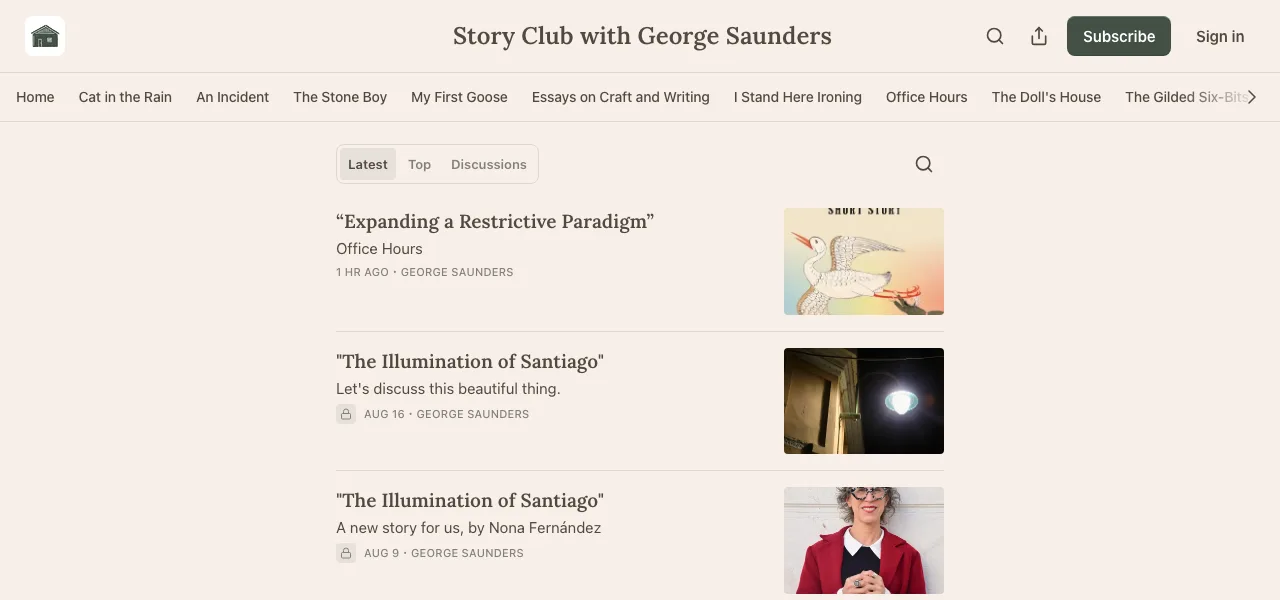
The clearest public example is Story Club with George Saunders, which has been running since December 2021 and reports over 330,000 subscribers at $6 a month or $50 a year as of August 20, 2026. It's a short-story craft class in a newsletter container, and Saunders built it deliberately that way. He's not a Ruzuku customer and he has never called it a course; he puts the word "syllabus" in scare quotes himself. Look at the navigation bar and you can see exactly what the software gives him.
How we verified
We captured this directly from georgesaunders.substack.com/archive in August 2026 — not from an affiliate roundup. The tabs are Substack Sections, a mailing-list segmentation feature, used here as a syllabus. Pricing pages change, so we date every screenshot.
Those tabs are the syllabus: more than forty sections, most named after a single short story. The index of what's been covered is a hand-typed list inside a blog post. In one of those posts Saunders describes asking Substack for a way to put every post into one file and spending a day converting the result, which came to 1,288 single-spaced pages. That's what a table of contents looks like when the container has no curriculum object in it.
Here's what the public pages show, stated as what's visible rather than what's impossible, since most of the publication sits behind a paywall:
- A locked post renders as "This post is for paid subscribers." That's a paywall, not an enrollment. There's no "start course" and no "resume."
- No lesson numbering and no enforced order. The archive lists newest first, and the story sections aren't sequenced 1 through 40.
- No progress indicator, no completion record, no graded work, no certificate. Writing exercises are assigned in prose and answered in the comments.
- No start date and no enrollment window. You subscribe and land wherever the newsletter currently is, with the whole paid archive open behind you.
Two smaller corrections while we're here, because both are widely repeated and both overstate what Substack offers. The poll feature is a poll, not a quiz: one vote per person, no correct answer, no score, and editing the poll wipes every existing vote. And there's no one-time sale. Substack documents four reader options, free, monthly, annual and founding member, and says outright that it "does not offer a 'yearly only' subscription plan option." The annual plan is a single payment that renews.
The business consequence of all that is one sentence, and it's the part nobody writes down: because every paid subscriber gets the entire back catalogue on day one, there is no such thing as being on week three, which invites subscribe, binge, cancel. That's a churn problem for you, not a feature gap in the software.
What Substack does well for building an audience
This section is longer than most competitor articles would make it, on purpose. If you're weighing a move, the things you'd give up matter more than the things you'd gain, and several of them are things we don't have.
- Scheduled, paywalled live video. You can schedule a stream between 15 minutes and three months out, gate it to paid subscribers only, invite up to two co-hosts, and the recording saves automatically as a draft post. That's a live-teaching tool, and it's free. We have built-in video meetings too, browser-based with no Zoom account needed, plus a Zoom integration when you want breakout rooms; what Substack adds on top is that your readers get the notification in an app they already have open.
- Chat with three levels of paywall. You can paywall individual threads, paywall the entire chat space, or let everyone reply while restricting who can start threads. That's more control than "a group chat room."
- Group subscriptions. Fixed-price unlimited-seat offers or per-seat discounts from two seats up, with a group admin who manages the roster and can pay by ACH. If a clinic or a school district wants to buy access for its staff, you can sell that on Substack today.
- Podcast hosting with RSS. Substack distributes to Apple and Spotify. Our audio hosting is lesson-scoped and doesn't do that, and I won't pretend otherwise.
- Discovery you don't have to build. Recommendations put your publication in other writers' subscribe flows, on their homepages, and in digest emails. Nothing on a course platform replaces that, ours included.
- A native app your readers already have, and full export of your posts and subscriber list. Substack's export article opens with "anything you publish on Substack is yours to own." The one documented limit is that the subscriber export can't include names.
Two of those are things Ruzuku doesn't do at all: we have no native student app, only mobile web and a PWA install, and we have no discovery network. If your readers live in the Substack app, moving them is a cost you should price in before you go any further.
Substack vs Teachable, and vs Kajabi: what are you actually comparing?
People search this comparison constantly and it rarely resolves, because the two sides aren't the same kind of thing. Substack is free to publish on, hands you distribution and an audience network, and takes a permanent 10% of subscription revenue. Teachable and Kajabi charge a flat monthly fee, hand you lessons, quizzes, progress tracking and one-time sales, and hand you no audience whatsoever. You're not choosing between two prices. You're choosing which problem you'd rather solve yourself.
Prices below come from our own pricing guides, each checked against the platform's live pricing page. Platform cost only; card processing of roughly 2.9% + 30¢ applies on every row including Substack's.
| Platform | Entry plan | Platform cut | Platform cost/yr at $5,000 gross | At $25,000 | At $100,000 |
|---|---|---|---|---|---|
| Substack | $0 | 10% | $500 | $2,500 | $10,000 |
| Teachable | Builder, $89/mo | 0% | $1,068 | $1,068 | $1,068 |
| Kajabi | Basic, $179/mo | 0% with Kajabi Payments | $2,148 | $2,148 | $2,148 |
| Patreon | $0 | 10% | $503 | $2,503 | $10,003 |
| Ruzuku Core | $99/mo, or $997/yr | 0% | $1,188, or $997 billed yearly | $1,188 | $1,188 |
Teachable's Starter plan is $39 a month but adds a 7.5% transaction fee, so Builder is the fair comparison against a 0% plan. Patreon's column adds its $0.25 monthly payout fee. Full breakdowns are in our course platform pricing comparison.
On price alone, Substack vs Teachable resolves twice and in opposite directions: at $5,000 a year in revenue Substack is cheaper and it isn't close, and at $100,000 a year Teachable costs a tenth of what Substack does. But if you asked me which one a teacher should be on, I'd want to know whether anyone has asked you when the next round starts. If they have, the fee schedule isn't the question you're really asking. Our Teachable comparison goes feature by feature if that's the branch you're on.
Can you run both: grow the list on Substack, teach the cohort somewhere else?
Before any of the cost math matters, one question sorts this faster than a spreadsheet: has anyone asked you when the next round starts? If people have replied to your newsletter asking whether you do a group version, you already have demand for a product you haven't built, and no fee schedule changes what to do about that.
Running both is what most teachers I talk to actually do, and it's the version I'd recommend before any migration. The newsletter stays where it is and keeps doing the job it's good at. One program runs somewhere with a start date. Nothing gets moved, nothing gets announced, and if the cohort doesn't work you've lost six weeks and no readers.
Here's the split inside one teacher's catalogue. C. Susan Nunn runs Mountain Aura Publishing, teaching memoir and fiction writing alongside manuscript editing and publishing work; her signature class is "Mining Truth in Memoir." She writes a Substack, The Artisan's Guide, and she has taught on Ruzuku since 2014, on her own domain. The number that shows the difference is the discussions. Her memoir classes that run on scheduled dates reach 48, 50, 43 and 36 discussion topics inside a single run. Her open-access courses, same teacher, same material, no start date, run between 5 and 13. That's roughly three to ten times the conversation, out of nothing but a calendar, measured inside one person's catalogue rather than across a platform. The writing is where the thinking happens, and the class is where a small group finishes something.
Now the translation, which is the part worth doing on paper before you decide anything. Take your current paid-subscription revenue and divide it by a cohort price:
| Your Substack today | Gross per year | Seats to match at $297 | At $497 |
|---|---|---|---|
| 60 subs at $7/mo | $5,040 | 17 seats | 11 |
| 100 subs at $50/yr | $5,000 | 17 seats | 11 |
| 500 subs at $50/yr | $25,000 | 85 seats, or about 21 across four runs a year | 51 |
| 2,000 subs at $50/yr | $100,000 | 337 seats, or about 28 across twelve runs | 202 |
$297 is illustrative, not typical. Run this row at whatever you'd actually charge before you believe it. I'm not quoting a Ruzuku price median to anchor it, because our price field records each payment-plan installment separately from a one-time full price, so a median off it isn't a course price. Most enrollments on the platform are open-access or on-demand rather than scheduled, which is a different product from six live weeks with someone who already pays to read you. What our data cannot tell you is what you can charge, and if you don't know, that's the question to answer before the platform one. Our course pricing guide works through it on this same data.
Selling once instead of twelve times also costs less to process. Twelve monthly $8 charges pay Stripe $7.06 a year; one $96 charge pays $3.08. And a one-off invoice skips Stripe's 0.7% billing fee entirely, which Stripe's own pricing page excludes from one-time charges. That's $3.97 per student per year, or 4.14% of the revenue, moved from Stripe to you.
The policy question comes up every time, so here's the actual wording. Substack says it doesn't "permit publications that are set up with the sole purpose of advertising an external product or service, distributing offers and promotions, or similar activity." Sole purpose is the whole clause, and most articles quoting this sentence drop it. A teacher who writes a newsletter and also runs a cohort isn't near that line. A publication that exists only to funnel readers into a paid offer is what the policy is written to catch. Read it yourself before you build something that depends on it.
If the constraint on your side is list size rather than platform, that's a different article: selling a course to a small audience and launching with no audience at all both work through it without assuming you have 900 readers to start from.
What happens to completion when the course has no start date?
We can measure one side of this directly. In August 2026 we pulled completion across 26,632 courses and 1.3 million enrollments on Ruzuku, using the platform's own binary completion record, the course_completed_at flag, rather than anything self-reported. The finding to start with is about week one: 78.3% of students who are active in their first week finish the course, against 17.2% of students who aren't. A start date is the only thing that makes week one exist. Below are three more cuts of the same data, measuring three different things, each labelled with what it counts.
Read those as observational associations across creators who chose their own formats, not as a controlled trial. Teachers who run scheduled cohorts are probably more hands-on to begin with, and that shows up in the numbers next to the format itself. I'd still take the cohort-size finding seriously, because it points the opposite way from how a newsletter grows. A 2,000-subscriber list is the worst shape in that table for getting anyone to finish anything, and the seats table in the last section says you'd only need 17 people to replace a 100-subscriber Substack.
The counterweight, and it's a fair one: plenty of Ruzuku subscriptions are priced in the same range as a Substack tier. Moving doesn't automatically let you charge more. What changes is what you can build for the people already paying you.
Who should keep growing on Substack and not touch a course platform yet?
Most articles in this category conclude "switch." The math above says that's wrong for a specific and fairly large group, so here's the group, with numbers attached instead of adjectives.
Stay on Substack and add nothing, not a cohort and not a platform, if every one of these is true. Miss any single one and the answer still isn't "switch." It's "run one cohort and change nothing else."
- Nobody has asked you when the next round starts. Not one reply, not one message, not one "do you ever do a group version of this?" If somebody has asked, even once, even six months ago, then the fee tables above are answering a question you aren't asking. A cohort is revenue you don't have yet, not revenue you'd be relocating.
- Your material works read in any order, and you don't need to know who finished anything. An archive that reads well backwards is a publication, not a course in the wrong software.
- You're under 124 paid subscribers at $8 a month, or under 238 at $50 a year, and you don't expect to cross that in the next two quarters. Below that line the 10% costs less than $99, so moving the newsletter itself would cost you money. That test says nothing about adding a cohort next to it.
- You can name roughly what share of new subscribers arrive through Recommendations or the app, and that share is large enough that you'd notice losing it. Discovery is a service you're paying 10% for. If you can't estimate the number, that's worth an afternoon in your stats page before you decide anything.
- Your readers open the Substack app rather than email, and you've asked at least a few of them whether they'd follow you to a browser. We have no native app, so this one is a cost of moving rather than a talking point.
- Nobody needs a certificate, a completion transcript, or continuing-education documentation. The moment somebody does, you're comparing against $199 a month and the break-even doubles.
If you're an essayist with 90 paying readers at $8, writing when you have something to say and nobody asking you for a group version, you're the person that list describes and I'd leave you exactly where you are. Substack takes about $125 a month from you. We'd take $152 for the same $720 of revenue and hand you a curriculum builder you don't need yet.
Most people reading this miss one of those bullets, usually the first, and then take the list as permission anyway, because it's the section that sounds like a verdict. So here it is without the hedge. If somebody has asked you when the next round starts, that list isn't about you. And none of the six things Substack does well go away when you run a cohort somewhere else: the newsletter stays, the recommendations keep running, the app keeps working. You add one thing with a start date on it. Seventeen seats. If it works you'll know inside six weeks, and if it doesn't, your subscription revenue never moved.
So how do you make the jump from subscribers to a cohort?
Under about $990 a month in paid subscriptions, Substack is the cheaper place to keep your newsletter, and I wouldn't move it. That was never the interesting question. Above that line the 10% keeps scaling and a flat fee doesn't: at 2,000 subscribers paying $8 a month, the gap is $18,012 a year, which is when moving becomes its own argument.
Cost usually isn't what decides it. The question underneath is whether you're publishing or teaching, and those need different containers. If your readers are reading, a newsletter is the right shape and Substack builds a good one. If they're trying to get somewhere, they need a week one, a sequence, somewhere to ask the question they're embarrassed by, and something that records the fact that they finished. No fee schedule changes that.
A concrete first step, and it takes an afternoon: pick the five most engaged people on your paid list. Email them and ask whether they'd join a six-week version of the thing you've been writing about, starting on a date. Then set up a free Ruzuku account and build it for those five.
The free plan caps you at five students at a time, which is the wrong size for a newsletter and the right size for a test. It also includes sales pages and payments, and every Ruzuku plan including Free charges zero transaction fees, so you can charge those five and keep everything but your payment processor's cut. Five seats at $297 is $1,485 for six weeks of work on a plan that costs you nothing, which is more than four months of what a 60-subscriber newsletter at $7 nets you. If those five finish and ask when the next one starts, that's when Core at $99 a month starts making sense, and by then one seat covers three months of it. Your Substack keeps running the whole way through. No credit card, and a person answers the support email.
Common questions about Substack for course creators
Can you actually run a course on Substack?
You can publish a sequence of paid posts, but Substack has no course product. Its help center ran 385 articles on August 20, 2026, and not one title contains the words course, class, lesson, curriculum, cohort, certificate, quiz, module or syllabus. What creators use instead is Sections, which Substack describes as a way to "create different mailing lists associated with distinct topics", an audience segment rather than a curriculum. There is no enrollment date, no lesson order, no progress record, and every paid subscriber gets the whole paywalled archive on the day they join.
At how many subscribers does a flat-fee course platform cost less than Substack?
At about $990 a month in paid-subscription revenue, which is 124 subscribers at $8 a month or 238 at $50 a year. That is where Substack's 10% equals Ruzuku Core's flat $99 a month. Stripe charges roughly the same on both sides, so processing mostly cancels out of the comparison. If you need completion certificates, a custom domain, or white-label branding, you are comparing against Ruzuku Pro at $199 a month and the line moves to about $1,990 a month: 249 subscribers at $8, or 478 at $50 a year. Billed annually, Core is $997 and the line drops to about $831 a month.
How much does Substack take from creators in 2026?
Substack takes 10% of each transaction, and Stripe takes 2.9% + $0.30 per charge plus a 0.7% recurring billing fee on top. On an $8 monthly subscription that is $1.39 of every $8, or 17.4% of gross. On a $50 annual subscription it is $7.10, or 14.2%. Publishing is free at any list size, and a custom domain costs a one-time $50. The 0.5% legacy billing rate that applied to creators who connected Stripe before July 10, 2024 expired on June 30, 2025, so everyone pays 0.7% now. Checked against Substack's help center on August 20, 2026.
Why is an annual Substack subscription cheaper for the creator than a monthly one?
Because Stripe's flat 30¢ is charged per payment, not per year. Twelve monthly charges of $8 pay that 30¢ twelve times; one annual charge of $50 pays it once. The result is 17.4% of gross on the monthly plan against 14.2% on the annual one, for the same business and the same subscribers. Substack's own minimums are $5 a month and $30 a year on US-dollar Stripe accounts, and at the $30 floor the percentage model holds out longest: break-even against a flat $99 does not arrive until about 397 subscribers.
Substack vs Teachable: which one does a course creator need?
They solve different halves of the problem, which is why the comparison rarely resolves on price alone. Substack costs nothing to publish, gives you email delivery, a recommendation network and an app your readers already have, and takes 10% of subscription revenue forever. Teachable costs a flat $89 a month on Builder (Starter is $39 but adds a 7.5% transaction fee) and gives you lessons, quizzes, progress tracking and one-time sales, with no audience attached. At $25,000 a year in revenue, Substack's cut is $2,500 and Teachable Builder is $1,068. Plenty of teachers run both.
Can you sell a one-time course or workshop on Substack?
No. Substack documents four reader options, free, monthly, annual, and founding member, and all of the paid ones renew. Its own help center states that Substack "does not offer a 'yearly only' subscription plan option," and the annual plan is described as a one-time payment that automatically renews. If you want to sell a six-week program once, at one price, with no renewal, you need a checkout somewhere else. That also changes the fee math: a single charge skips Stripe's 0.7% recurring billing fee, which Stripe excludes from one-off invoices.
Is it against Substack's rules to promote my own course to my subscribers?
No, as long as promotion is not the whole point of the publication. Substack's policy says it does not "permit publications that are set up with the sole purpose of advertising an external product or service, distributing offers and promotions, or similar activity." Those three words, sole purpose, are doing the work: a teacher who writes a newsletter and also runs a cohort is nowhere near that line. The same page notes Substack builds no features for affiliate links or advertising, because it is built around subscriptions. Read the wording yourself before you design a funnel around it.
Related resources
- How Ruzuku works — what a scheduled cohort looks like from the teacher's side
- Course platform cost calculator — put your own subscriber count against the break-even
- Patreon fees for course creators — the same 10% model, a different product shape
- The fees that don't appear on pricing pages — what to audit before you move anything
- How to sell a course with a small audience — if the list, not the platform, is the constraint